A sales incentive plan (SIP), or sales incentive program, can look clear in a compensation slide and still be difficult to operate.
The slide says “reward growth.” The salesperson asks which deals count. Finance asks when the amount is earned. The manager asks what happens when an account changes owner halfway through the quarter.
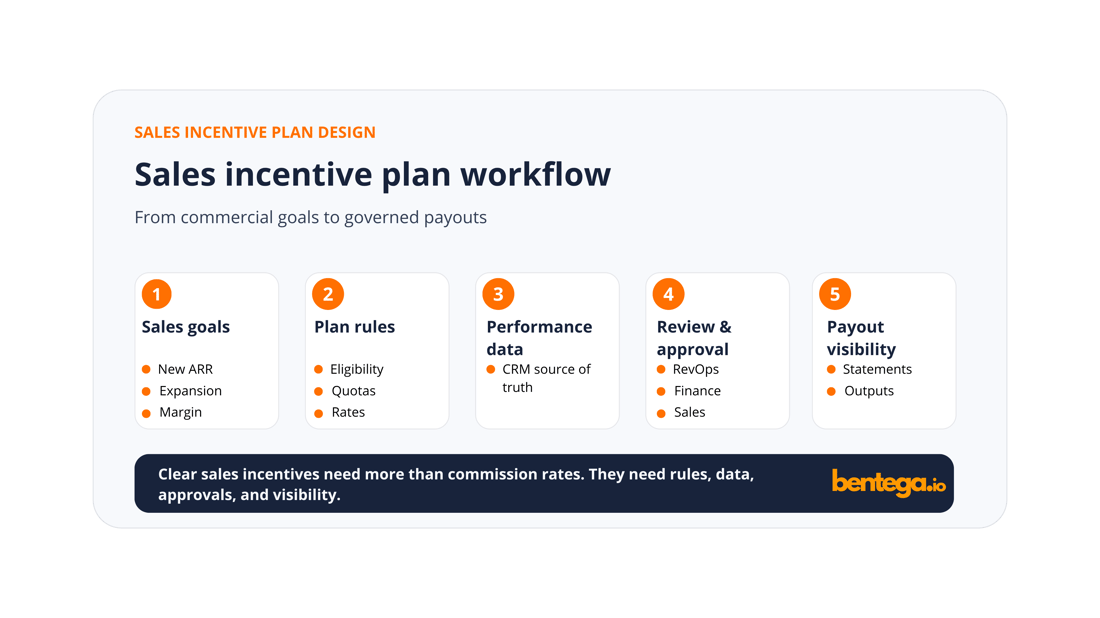
A complete plan connects those questions. It defines the performance being rewarded, who is eligible, how amounts are calculated and how the business reaches a reviewed result.
The objective is not to include every possible metric. It is to create a small set of incentives that employees can understand and the company can operate consistently.
Last updated: 2 September, 2026.
What belongs in a sales incentive plan?
A sales incentive plan sets out the variable rewards attached to sales-related performance. It may combine commissions, bonuses and time-limited incentives, depending on the role and objective.
| Element | What it means | Example |
|---|---|---|
| Commission | Variable pay calculated from an eligible sales measure or event | 6% of qualifying new-business contract value |
| Bonus | Variable pay linked to specified results or conditions | A team bonus calculated against an agreed quarterly target |
| SPIF | A time-limited sales incentive with defined conditions | A fixed reward for a qualifying campaign outcome during a stated window |
| Target variable pay | The variable amount expected when the plan's target conditions are met | $40,000 annually |
| On-target earnings, or OTE | Base salary plus target variable pay | $60,000 base + $40,000 target variable = $100,000 OTE |
OTE is not an additional payment type. Avoid writing “OTE-based payouts” without specifying the underlying components and calculations. Reaching one headline sales quota also does not necessarily produce OTE if another component has separate target conditions.
The guide to on-target earnings explains the relationship between base salary and target variable pay. For the broader role and pay framework, see the sales compensation guide.
1. Start with the business outcome and the role's contribution
Translate the business objective into work the participant can meaningfully influence.
“Increase revenue” is not enough. Does the business need new customers in a defined segment, profitable expansion, better-qualified pipeline or retention of suitable accounts? Each objective points toward different measures and responsibilities.
Then check the handoffs. An SDR rewarded for meetings, an AE rewarded for signed revenue and a customer success team rewarded for retention may be working with the same customer under different definitions of success.
Different incentives can coexist. The problem is rewarding a local result that creates avoidable difficulty for the next team. Agree what a useful handoff looks like before selecting the metric.
For each proposed component, ask:
- What behavior or outcome should this reward?
- Can the participant influence it?
- What evidence will show that the outcome qualifies?
- Could the measure be met in a way that harms the wider objective?
- Who receives the work or customer next?
2. Define participants, dates and eligible performance
A plan needs a defined population and a period of application. Record the participating roles, effective dates and the treatment of changes during the period.
Eligibility also needs to operate at transaction level. Specify the products, customers or events that count, the credited owner and the relevant earning date. Do not leave cancellations, shared deals and non-standard discounts to informal interpretation.
For subscription businesses, distinguish recurring contract value from total multi-year value and collected cash. The SaaS commission structures guide provides examples of these different bases.
Employment agreements and applicable local requirements may affect earning, changes and recovery rules. The commercial plan needs appropriate review before it is applied.
3. Reconcile target variable pay with the actual formulas
Work backward from the target earnings and the conditions required to earn them.
For a single fixed-percentage component, a useful starting calculation is:
Target commission ÷ target eligible sales = commission rate
That shortcut does not fully describe a plan with tiers, thresholds or multiple components. Calculate every component at its target condition and then add them together.
Worked example: individual commission plus a team bonus
Consider a fictional AE team plan. All amounts are illustrative US dollars before employee taxes, not salary benchmarks or recommended quotas.
For a fully eligible employee working the complete year:
- Annual base salary: $60,000.
- Annual target variable pay: $40,000.
- Annual OTE: $100,000.
- Calendar-quarter measurement, with target variable pay of $10,000 per quarter.
- Individual component: $7,500 at target per quarter.
- Team component: $2,500 at target per quarter.
The plan assigns 75% of target variable pay to the individual component and 25% to the team component. That allocation is an editorial example, not a universal recommended pay mix.
Individual commission
The employee's quarterly quota is $125,000 of eligible new-business annual contract value. The rate is 6% from the first eligible dollar:
$125,000 × 6% = $7,500
This component has no threshold, accelerator or cap in the example. Eligible value excludes taxes and one-time service fees, and each transaction is credited once under the ownership rule.
Team bonus
The team's quarterly target is $500,000 of eligible new-business annual contract value. The participant earns $2,500 at 100% team attainment, calculated proportionally from zero and capped at 120% of that bonus:
$2,500 × min(team eligible value ÷ $500,000, 1.20)
The formula assumes a non-negative team value. The maximum team bonus for the participant is $3,000 per quarter.
Individual sales also count toward the team result. This is intentional: the two components reward individual production and shared team performance. It is not permission to duplicate a transaction inside either component.
Team membership is fixed for the quarter in this example, with no mid-period transfers or adjustments. A real plan must define those cases separately.
| Quarterly scenario | Individual eligible value | Individual commission | Team eligible value | Participant's team bonus | Total variable pay |
|---|---|---|---|---|---|
| Below both targets | $100,000 | $6,000 | $400,000 | $2,000 | $8,000 |
| At both targets | $125,000 | $7,500 | $500,000 | $2,500 | $10,000 |
| Above both targets | $150,000 | $9,000 | $650,000 | $3,000 | $12,000 |
At both targets in every quarter:
$60,000 base + (4 × $10,000 variable pay) = $100,000 OTE
If the employee reaches the individual target but the team reaches only 80% of its target, quarterly variable pay is $7,500 + $2,000 = $9,500. Repeating that result for four quarters produces $98,000 total annual compensation, not OTE.
The team component therefore needs a credible connection to collaboration and results the participant can influence. A mathematically clear formula can still be a poor incentive if the measure is outside the role's practical control.
4. Separate earning, calculation, approval and payment
These events are related but not interchangeable.
In the worked example, suppose the written plan makes qualifying contract acceptance the earning event. The business calculates results from the source records, reviews them and uses its normal downstream process to make payments.
Approval checks that the calculated result follows the plan. It should not be described as an unrestricted opportunity to change an amount already earned. Likewise, a payment date does not automatically define when the commission was earned.
Document:
- The event and evidence that establish eligibility.
- The date used to assign performance to a period.
- The calculation and review cutoff.
- The person responsible for resolving missing or disputed information.
- The expected downstream payment process and schedule.
- The treatment of corrections after approval or payment.
If the earning event is customer collection instead, explain partial receipts and allocation. Do not describe a plan as “commission only after payment” while also promising commission at signing under the same rule.
5. Assign ownership for the data and decisions
Several functions may contribute to the plan. Assign named owners for the decisions, not just departments that might be involved.
| Responsibility | Decision to document |
|---|---|
| Business objective | Who confirms that the measure supports the intended outcome? |
| Plan design | Who approves components, rates, eligibility and effective dates? |
| Source data | Who maintains the qualifying values, event dates and ownership records? |
| Calculation preparation | Who checks that the right rules and records were used? |
| Review and approval | Who can approve, reject or request a correction, and on what basis? |
| Downstream payment | Who handles payroll or payment processing after the reviewed result is available? |
| Employee communication | Who explains the plan and responds to questions? |
One person may hold several responsibilities in a small company. The responsibilities still need to be visible.
6. Test the plan before announcing it
An at-target example is necessary, but it is not enough. Prepare expected results for cases that expose ambiguity.
For the worked example, test:
- Zero eligible performance.
- The individual target with the team below target.
- The team target with the individual below target.
- Team performance exactly at 120% and immediately above it.
- A shared deal or duplicate record.
- An employee joining or moving teams during the quarter.
- A contract cancellation or value correction.
- A late record received after the review cutoff.
Confirm both the payment amount and the operational decision. Who investigates the duplicate? Which period receives the late record? Does a cancellation affect the original earning event, or require a separately reviewed adjustment?
For affordability, compare compensation with the relevant delivery costs, margins and broader employment costs. Do not use a lower modeled commission total as proof that a plan will generate better business performance.
7. Communicate the plan using examples employees can follow
Give participants the written rules and enough examples to understand the result. Include at least one ordinary case, one at-target case and one exception relevant to their work.
Ask employees to explain how their target earnings are reached. If the answer depends on an unstated conversion assumption, ambiguous ownership or a hidden team condition, the plan is not yet clear enough.
Record the effective version and communicate later changes with their dates. Avoid quietly replacing rules in a document while older transactions are still being reviewed under a different version.
How should a SPIF fit into the plan?
A time-limited incentive should have a specific objective, eligibility rule, start and end dates, and an owner for review. Explain whether it is additional to the normal commission or changes another component.
Do not add a campaign reward to advertised OTE without saying how it contributes to the at-target calculation. The example above reaches its $100,000 OTE without any SPIF.
Use a SPIF to address a defined campaign need rather than as an unexplained permanent supplement. Read the SPIF guide for the distinction between a temporary incentive and the ongoing plan.
Where Bentega fits
Bentega organizes incentive compensation through plans and calculation components, with participant eligibility, approval steps and access to calculation history. It can support different variable-pay components within the wider incentive process.
The practical value is connecting the agreed rules with calculations and reviewed results, while giving employees access to relevant compensation information in their portal. The company still needs to supply appropriate source data and make the underlying policy decisions.
See the Bentega product overview to assess how the platform fits the calculation, review and visibility requirements of your plan.
Frequently asked questions
What is the difference between a sales incentive plan and a commission plan?
A sales incentive plan can include several forms of variable reward, including commissions, bonuses and temporary incentives. A commission plan focuses on the rules for commission. The terms sometimes overlap, so describe the actual components rather than relying on the title.
Is OTE a separate incentive component?
No. OTE is base salary plus target variable pay. The component formulas and their target conditions must add up to the advertised target amount; OTE is not another payment added on top.
Can a plan combine individual and team incentives?
Yes, where both support the intended outcome. Define the measures, the participant's influence and whether the same sale intentionally contributes to both components. Make team membership and changes during the period explicit.
How often should a sales incentive plan be reviewed?
Monitor calculation issues and employee questions during each operating cycle. Revisit the design at an agreed planning interval or when strategy, roles or economics materially change. A design review does not mean silently changing rules for performance that has already occurred.
Finish with a plan that works beyond the presentation
A complete sales incentive plan makes its target earnings explainable, its data requirements visible and its review responsibilities clear. That matters whether it starts in a controlled spreadsheet or is configured in software.
Before launch, confirm that:
- Each component rewards a defined contribution to the business objective.
- The formulas reach OTE under explicit at-target conditions.
- Eligibility, changes, reviews and downstream payment responsibilities are documented.
Use the sales commission guide and template to turn the design into documented rules and test cases before launch.
Explore More
- Annual Incentive Plan
- Short-Term vs. Long-Term Incentives
- Employee Incentive Plan: How to Design an Effective Program That Drives Results
- Types of Incentive Pay: Which One Is Right for Your Business?
- Performance Metrics for Incentive Compensation: What to Measure
- Common Mistakes in Incentive-Based Compensation and How to Avoid Them
Bentega helps you design, automate, and scale performance-driven sales incentive plans and commission programs. Learn more at Bentega.io.