Skip to content

Sales Commission Structure: How to Design a Plan That Drives Revenue

A well-designed sales commission structure can be the difference between a predictable, high-performing sales engine and a constant battle over targets, payouts, and fairness. The challenge isn’t just “what rate should we pay” — it’s how the entire structure shapes behavior, risk, and revenue.

This guide walks through the most common models, when to use them, and how to choose a structure that motivates your team, protects margins, and scales with your go-to-market strategy.

💡 New to commissions overall? Start with the foundational Sales Commission Guide first, then come back here for structure design.

What Is a Sales Commission Structure?

A sales commission structure is the rulebook that defines how salespeople earn variable pay. It specifies:

  • How commission is calculated (percentage, flat amount, margin-based, etc.)

  • When it’s earned (per deal, after quota, at renewal)

  • Who gets credit for which deals

  • Any accelerators, decelerators, caps, or draws

In other words, the structure translates company strategy into day-to-day seller incentives. If it’s clear and consistent, reps can easily predict what they’ll earn and focus on the right deals. If it’s vague or overcomplicated, motivation drops and disputes rise.

For sales and finance leaders, a strong structure also:

  • Keeps customer acquisition cost (CAC) and cost of sales under control

  • Aligns payouts with profitable deals (not just any revenue)

  • Creates a framework you can roll out across regions, products, and roles

Why Commission Structure Matters More Than the Rate

When creating a commission structure, many teams start with the rate (“Let’s pay 10%”) and bolt on rules over time. That’s how plans become messy.

A good sales commission structure focuses on these questions first:

  • What behavior do we want more of? New logos, multi-year deals, upsells, renewals, margin discipline?

  • What risk can the company carry? Higher variable pay means more upside, but also more volatility.

  • What level of control does each role have? A hunter AE vs. a renewal CSM vs. a partner manager.

  • What data is reliable? If you can’t measure it, you probably shouldn’t pay on it.

Once those are clear, the commission rate is just one of several levers you adjust to balance motivation and affordability.

For broader incentive strategy beyond sales, see the Incentive Compensation Guide and the KPIs & Metrics Guide.

Core Components of a Sales Commission Plan

Before you choose a sales commission structure, make sure these basics are defined:

Pay Mix

Pay mix is the split between fixed salary and variable pay (for example, 60/40 or 50/50). Hunter roles typically carry more variable risk; farmer or renewal roles often have a higher fixed portion.

Pay mix should align with:

  • How much control a role has over revenue

  • The length and complexity of the sales cycle

  • Market expectations for similar roles

Performance Metrics

The metric you pay on should be:

  • Measurable and reliable

  • Within the rep’s influence

  • Closely tied to your strategy

Common performance metrics include new ARR, upsell ARR, gross margin, or renewals. For help choosing metrics, use the KPIs and Metrics Guide as a reference.

Quota and Targets

Quotas should be ambitious but realistically attainable. Consistently low attainment signals that quotas — and by extension, the commission structure — need to be recalibrated.

Common Sales Commission Structures (With Examples)

There’s no one-size-fits-all model. Most teams combine a primary sales commission structure with a few strategic modifiers (accelerators, gates, residuals) to match their go-to-market.

For a detailed breakdown of each model with advantages and drawbacks, see Sales Commission Structures: Models, Pros and Cons.

Below are the most common structures used in SaaS and B2B sales.

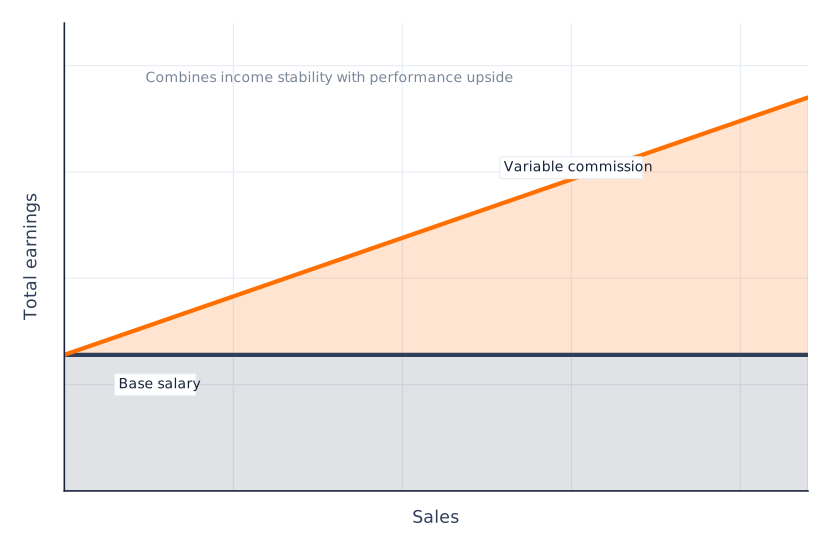
Base Salary Plus Commission Structure

Base Salary plus Commission

Base salary plus commission is the default model for most SaaS sales teams.

  • What it is: Reps receive a fixed base salary plus a variable percentage on deals.

  • Best for: B2B sales with moderate–high deal complexity.

  • Benefits: Income stability, clear upside, easier hiring and retention.

Example:
An AE with €60,000 base and €40,000 on-target commission earns 10% on new ARR. At 100% of quota, they reach their On-Target Earnings (OTE) of €100,000.

To design OTE aligned with your structure, see the On-Target Earnings Guide.

Flat-Rate Commission structure

Flat-Rate Commission

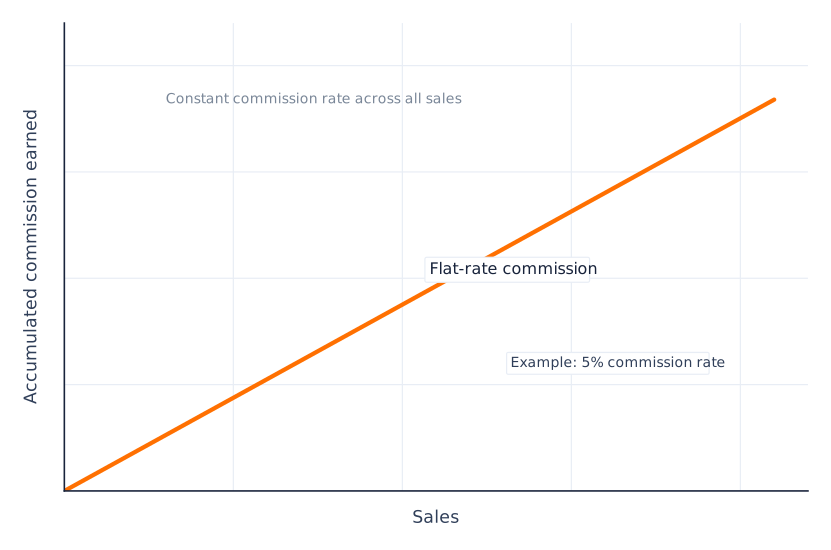
With a flat-rate commission you pay/receive the same percentage (or fixed amount) on each eligible deal, regardless of volume.

  • Best for:
    Simple, transactional motions (e.g., SDRs booking meetings with a flat bounty).

  • Pros:
    Easy to explain and administer.

  • Cons:
    Doesn’t strongly differentiate top vs. average performers.

Example:
An SDR earns €150 for every qualified opportunity created that meets clear criteria.

Flat-Rate Commission structure

Straight Percentage-Based Commission

A straight-percentage based commission you pay/receive a constant percentage of revenue or ARR with minimal extra rules.

  • Best for:
    High-volume sellers, channel partners, or situations where you want to tightly link revenue to pay.

Example:
Reps earn 8% of the first year’s ARR for every new subscription they close, with no quota gate and no tiers.

Tiered Commission structure

Tiered Commission

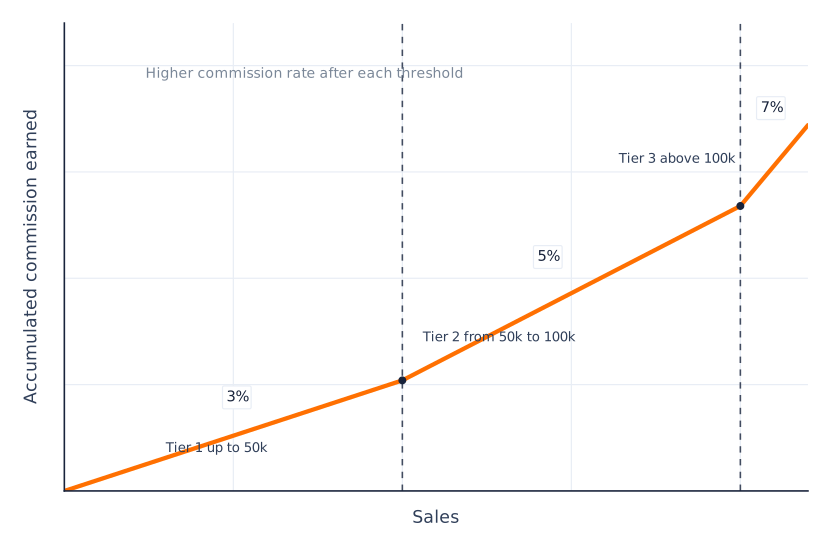
A tiered commission structure increases the commission rate at higher levels of attainment, creating a built-in accelerator.

  • Best for:
    Motivating overperformance and rewarding top reps.

  • Pros:
    Strong upside once reps cross key thresholds.

  • Cons:
    More complex to calculate manually; requires accurate data.

Example:

  • 5% on new ARR up to €200,000

  • 7% between €200,001 and €400,000

  • 10% above €400,000

This encourages reps to push beyond “good enough” and drive additional pipeline late in the period.

For a worked tiered commission structure example including ROI calculations, see our dedicated guide.

Compensation Plan and policy download free guide
Accelerated Commission structure

Accelerated Commission

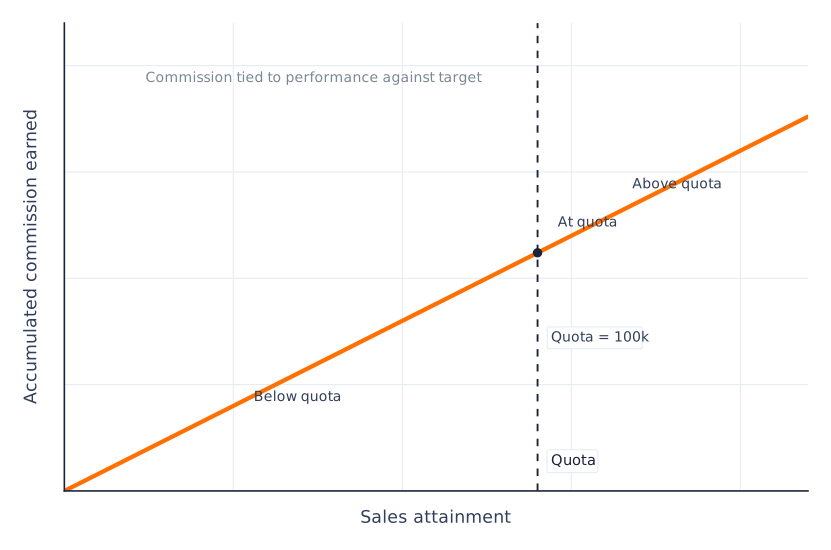
An accelerator increase the rate after a rep exceeds quota or a specific milestone. They can be layered onto flat, straight-percentage, or tiered plans.

Example:

  • 6% on all deals up to 100% of quota

  • 9% on all deals above 100% of quota

Accelerators are powerful, but they also increase cost of sales — finance teams should model different attainment scenarios before rollout.

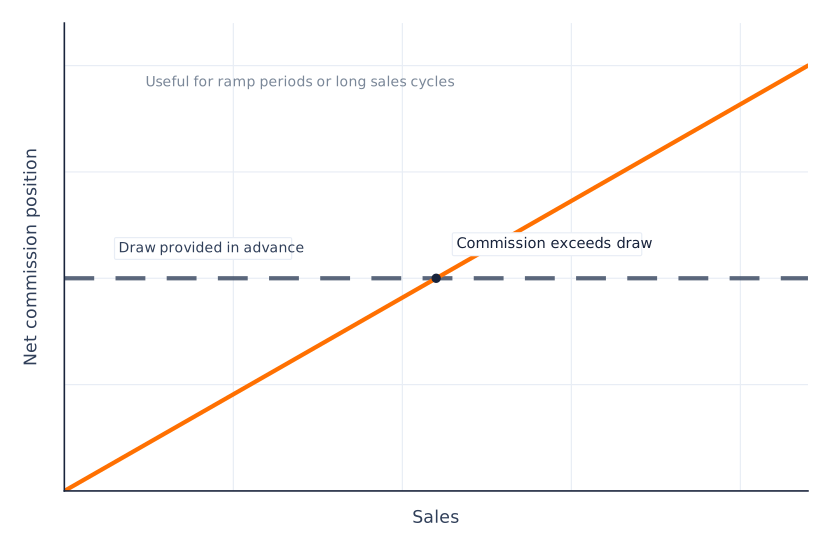
Draw Against Commission

A draw is an advance on future commissions to smooth income, especially when a rep is new or when seasonality is high.

  • Best for:
    New territories, new hires in ramp, lumpy pipeline.

  • Types:
    Recoverable draws (paid back via future commissions) and non-recoverable draws (essentially temporary guarantees).

Example:
A new AE gets a €3,000 monthly recoverable draw for three months. As they start closing deals, their earned commissions offset the draw.

For more context on when a draw against commission makes sense, we cover examples and trade-offs in our commission structures overview.

Gross Margin Commission

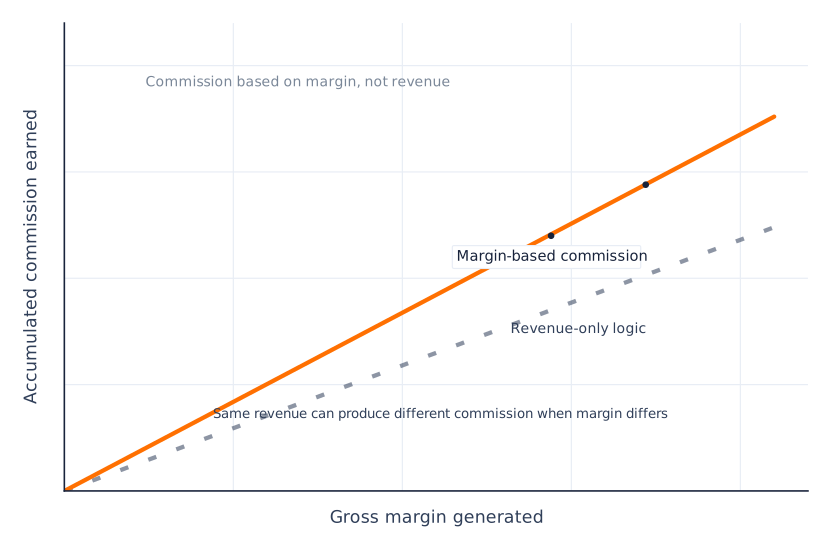
Instead of paying on revenue, you pay a percentage of gross margin (revenue minus cost of goods or services).

  • Best for:
    Businesses with wide pricing flexibility or thin margins where discount discipline is critical.

  • Benefit:
    Reps are rewarded for profitable deals, not just large topline numbers.

Example:
If a deal generates €20,000 in revenue and €12,000 in cost, gross margin is €8,000. At a 12% margin commission, the rep earns €960.

Guide to Mastering Sales Commissions

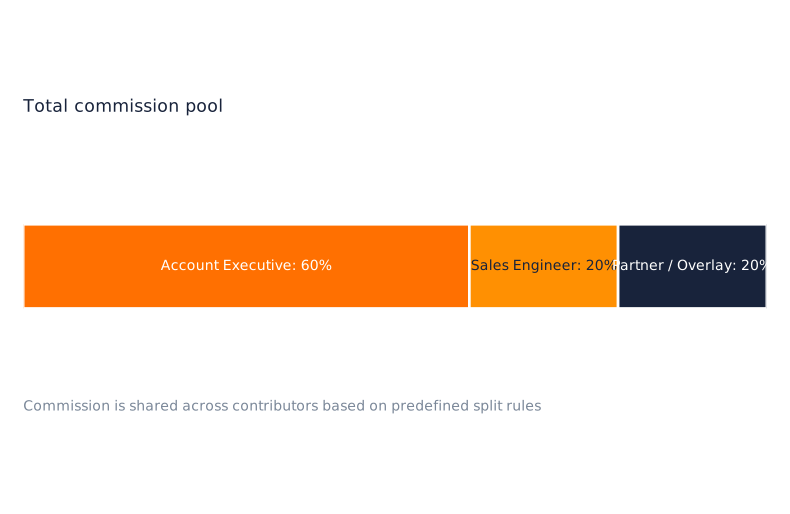
Split Commission

Split credit ensures everyone involved in complex deals are compensated fairly.

  • Use cases:

    • AE + SDR

    • AE + Sales Engineer

    • New Business AE + Account Manager for expansion

Example:
New ARR commission is 8%. AE gets 60%, SDR gets 40% of the commission amount on qualified deals that close.

To keep trust high, define split rules clearly and enforce them consistently in your system.

Residual Commission structure

Residual Commission

Residuals pay a smaller ongoing commission as long as the customer stays active, renews, or expands.

  • Best for:
    Subscription and usage-based models where long-term relationships matter.

  • Benefits:
    Aligns incentives with retention and customer health.

Example:
Reps earn 4% on first-year ARR and 1% on renewals for two years.

For the impact of this kind of compensation model, see the article The Impact of Commission-Based Pay on Sales Performance.

Capped Commission structure

Capped Commission

Capped commission refers to a commission structure in which there is a maximum limit, or "cap," on the amount of commission a sales representative can earn. Once the sales rep reaches this predefined limit, they can no longer earn additional commissions for that period, regardless of how much more they sell.

Practical Example:

A sales rep earns a 10% commission on all sales. The company has set a commission cap at $50,000 per quarter.

  • Q1 Sales: The rep generates $400,000 in sales, earning $40,000 in commission (10% of $400,000).
  • Q2 Sales: The rep generates $600,000 in sales, which would normally earn them $60,000 in commission. However, due to the $50,000 cap, they only receive $50,000 for that quarter, and the remaining $10,000 in potential commission is not paid out.

Capped commissions are a tool that companies can use to balance rewarding high performance with managing their overall compensation budget, but they must be carefully structured to avoid negative impacts on sales motivation and overall company culture.

Flat-Rate Decelerator structure

Flat-Rate Decelerator

A flat-rate decelerator is a type of commission structure used to adjust the earning potential of a salesperson or agent based on their performance.

It typically comes into play when salespeople exceed certain sales targets or thresholds.

Initially, a salesperson is awarded a fixed commission per sale, irrespective of the individual transaction's value, ensuring a steady income stream from the get-go. Once a salesperson surpasses a predetermined goal or benchmark, the commission rate begins to taper off, effectively reducing. This strategy aims to regulate expenses, optimize profits, or ensure a fair distribution of rewards.

For example, in a case where a SDR has booked the maximum number of meetings the sales team can handle, the incentive to continue booking meetings diminishes significantly.

Role-Based Commission Structures

Different roles see different parts of the customer journey. Your commission structures should reflect that.

  • SDRs/BDRs: Often paid on meetings booked or qualified opportunities, with flat bounties or small percentages.

    For SDRs specifically, see our guide to SDR commission structure with concrete examples and plan templates.

  • Account Executives: Paid on new ARR, multi-year deals, and sometimes on expansion.

  • Customer Success / Account Managers: Paid on renewals, expansion ARR, NRR, or retention KPIs.

  • Channel / Partner Managers: Paid on partner-sourced revenue, influenced pipeline, or joint wins.

For individual sellers, a sales rep commission structure should be tightly aligned with the activities and outcomes they directly control.

Designing Your Commission Structure Step by Step

Use this process as a blueprint when building or updating your plan.

Step 1 – Define Objectives and Guardrails

  • What exactly do you want more of (new logos, multi-year, expansion, margin)?

  • What’s your acceptable range for cost of sales and variable payout as a percentage of revenue?

Document these before you touch any rates.

Step 2 – Choose a Primary Structure

Decide if your baseline will be:

  • Base + straight percentage

  • Base + tiered or accelerated

  • Base + quota-gate plan (commission only after threshold)

The most typical sales commission structure in SaaS is base salary plus tiered or accelerated commission on first-year ARR. If you’re worried about pitfalls as you choose a model, review the most common sales commission challenges and how to fix them before rolling out a new plan.

Step 3 – Add Strategic Modifiers

Optionally add:

  • Accelerators for over-attainment

  • Clawbacks on churned deals

  • Gates (e.g., no commission on deals below a certain ACV)

  • Spiffs or bonuses for strategic products or segments (see the SPIF Guide)

Step 4 – Test on Historical Data

Before rollout:

  • Run last 6–12 months of deals through the new structure.

  • Compare actual vs. projected payouts, margin, and attainment.

  • Check for edge cases — extreme over-earners or underpaid top performers.

Step 5 – Communicate Clearly

Reps should be able to explain how they’re paid in a few sentences. Provide:

  • A concise plan document

  • Examples of deal scenarios and resulting payouts

  • Access to a live dashboard where they can see their numbers

For the broader impact on engagement, see the Work Motivation Guide.

See Commission Structures in Action

Designing the plan is only half the battle — administering it in spreadsheets quickly becomes painful.

With Bentega, you can:

  • Model and compare different commission structures in minutes

  • Automate calculations, approvals and payout files

  • Give every rep up-to-date visibility into attainment and expected earnings

Book a Demo to see how Bentega simplifies commission management for Finance, Sales, and RevOps teams.

Product Bentega

Best Practices for Managing Commission Structures

Keep It Simple (But Not Simplistic)

If your best rep and your CFO can’t agree on how a payout was calculated, the plan is too complex. Start simple and layer complexity only where it clearly supports strategy.

Align with KPIs and Strategy

Use a small set of KPIs that map directly to business goals — growth, profitability, retention. If a KPI is on the dashboard but not linked to pay, it won’t get the same focus.

For ideas on turning your commission plan into a stronger motivation driver, see how to motivate sales teams with effective commission plans.

Review Regularly, Not Constantly

You should review structures at least annually (ideally every quarter), but avoid changing the rules mid-year unless there’s a major strategic shift. Constant changes erode trust.

Automate for Accuracy and Trust

Manual processes create:

  • Calculation errors

  • Delayed payouts

  • Reps spending time recalculating instead of selling

Automating with a dedicated platform like Bentega reduces payout disputes and gives leadership reliable data to make adjustments.

How Bentega Helps You Manage Commission Structures

Whether you’re rolling out a new commission structures framework or cleaning up years of ad-hoc changes, Bentega gives you a single source of truth for incentive compensation:

  • Build multiple plans and structures for different roles and regions

  • Run “what-if” simulations before launch

  • Connect to your CRM and payroll for accurate, auditable payouts

  • Provide real-time dashboards so reps always know where they stand

Instead of wrestling with spreadsheets each month, you can focus on strategy — and your teams can focus on selling.

Key Takeaways

  • Your commission structure matters more than the headline rate — it shapes behavior, risk, and revenue quality.

  • Choose a primary model (base + commission, tiered, accelerated, etc.) and align it with clear KPIs and strategy.

  • Test new plans on historical data before rollout to avoid surprises in cost of sales or rep earnings.

  • Keep rules simple, communicate them clearly, and avoid frequent mid-cycle changes.

  • Use automation (like Bentega) to calculate payouts, track performance, and maintain trust at scale.

A smart commission structure is a blueprint for sustainable growth.

Frequently Asked Questions about Sales Commission Structures

What is a sales commission structure?

It’s the framework that defines how salespeople earn variable pay — including rates, thresholds, eligible metrics, and any rules around accelerators, caps, or draws. Think of it as the operating system for your sales incentives.

How do I know which structure is right for my team?

Start from your strategy and sales motion:

  • Short, transactional cycle → simpler, flat or straight-percentage models

  • Complex B2B deals → base + commission with tiers, splits, or residuals

  • Heavy focus on renewals → mix in retention and expansion metrics

Then pressure-test the model with historical data and a scenario analysis.

Should I cap commissions?

Caps protect budgets but can demotivate top performers if they hit the ceiling early. Many teams avoid hard caps and instead use guardrails (approval requirements, deal quality checks) for extreme outliers.

If you operate across multiple regions or countries, review the key legal considerations for structuring commissions globally before finalizing caps and guardrails.

How often should we change our commission structure?

Most companies refresh annually and make minor tuning during the year if needed. If you’re changing structures every quarter, reps may feel like the goalposts are moving — which can hurt performance and retention.

Ready to modernize your commission structures and get out of spreadsheet chaos?

Explore what Bentega can automate for your team on the Product page. Or go straight to a live walkthrough and Book a Demo.

  • Build custom models for any team or role.

  • Track payouts automatically and fairly.

  • Integrate CRM and payroll data seamlessly.

  • Give everyone full visibility into performance.

Commission management doesn’t need to be complicated — automate it with Bentega.

Sales Commission Structure: How to Design a Plan That Drives Revenue | Bentega