There is no universally best sales commission structure. The right model depends on the role, sales cycle, margin profile, level of individual influence, available data and behaviour the company wants to encourage.
This article compares the most useful types of sales commission structures and the practical trade-offs between them. It is designed to help you shortlist commission models, not recreate the complete plan-design process.
For the broader process, including objectives, eligibility, measures, rates, thresholds and governance, read our complete guide to sales commission structures.

Sales commission structures compared
The table below summarizes the common commission structures most teams consider. These sales commission structure examples are starting points for comparison rather than complete plan designs.
Caps and uncapped earnings can sit across several of these commission-based models, so they are better treated as a separate design choice rather than a standalone calculation model.
Base salary plus commission
With base salary plus commission, the participant receives fixed compensation plus variable earnings linked to defined sales results.
The base salary provides income stability. The commission component preserves a direct relationship between performance and additional earnings.
Advantages
- More income stability than commission-only compensation.
- Often practical for recruiting into roles where earnings take time to build.
- Keeps part of compensation linked to measurable performance.
- Allows the role to include important responsibilities that do not directly generate commission.
Disadvantages
- The company carries a higher fixed compensation cost.
- The fixed-variable mix needs to reflect the actual role.
- Too much or too little variable exposure can create a poor match between responsibility and reward.
A larger variable share is not automatically better. The appropriate balance depends on how much control the participant has over sales results and how much of the role is devoted to activities that are not directly commissionable.
Best fit
This structure is often more credible for consultative sales, longer sales cycles and roles that include account planning, discovery, internal coordination or other meaningful responsibilities beyond closing transactions.
Straight commission or commission-only
Under straight commission, compensation is primarily or entirely tied to commissionable results rather than a fixed salary.
This can create a very direct connection between outcome and earnings, but that connection is only credible when the participant has substantial influence over the outcome.
Advantages
- Very direct line of sight between commissionable results and earnings.
- Lower fixed compensation commitment for the company.
- Can suit highly independent selling situations where individual attribution is clear.
Disadvantages
- Earnings can vary materially between periods.
- The participant carries more income risk.
- The model becomes harder to justify when outcomes depend heavily on factors outside the participant's control.
When commission-only models work
A commission-only structure becomes more credible when:
- the participant has substantial influence over the sale;
- attribution is clear;
- the earning event is clearly defined;
- the applicable rate is easy to understand;
- the sales cycle provides a realistic opportunity to earn commission;
- enough opportunities exist for the participant to generate meaningful earnings;
- the commission rate appropriately reflects the income risk being transferred to the participant.
For example, a role where one person sources, manages and closes an identifiable transaction may create a clearer relationship between contribution and commission than a sales motion involving many departments.
When commission-only models fail
Commission-only becomes less suitable when the outcome depends substantially on marketing-generated demand, team selling, implementation capacity, customer success, product availability or other factors that the salesperson cannot reasonably control.
The same applies when attribution is unclear or the sales cycle is so long that earnings become disconnected from current effort.
Contractual terms and applicable employment requirements also need to be considered. The appropriate treatment can vary by jurisdiction, so companies should obtain relevant advice rather than relying on a generic commission model as legal guidance.
Flat-rate commission
A flat-rate model applies one consistent rate to the defined commissionable amount.
For example, a plan might use a fixed percentage for every eligible transaction regardless of quota attainment. The exact rate is less important here than the principle: the same rate applies consistently.
The commissionable amount does not have to equal total contract value. A plan might define eligible revenue, annual recurring revenue, gross margin, selected products or another value as the basis for commission.
Advantages
- Simple to understand.
- Relatively predictable to administer.
- Creates clear line of sight between eligible sales and earnings.
- Requires fewer rate conditions than tiered or quota-dependent models.
Disadvantages
- Does not differentiate strongly between adequate and exceptional performance.
- Can reward volume without distinguishing deal quality.
- May become poorly aligned when products or deals have materially different economics.
Best fit
Flat-rate structures tend to work better when products, margins, contract terms and the sales motion are reasonably consistent.
Where deal economics vary significantly, another basis such as margin or a more conditional rate structure may be more appropriate.
Tiered and accelerated commission
Tiered commission structures apply different commission rates at defined performance bands.
An accelerator is related but more specific. It increases the applicable rate once a defined threshold or quota condition has been reached.
For example, a plan might provide one rate up to quota and a higher rate above quota.
The critical design question is what the higher rate applies to.
A plan may state that the accelerated rate applies only to results above the threshold. Alternatively, it may apply retroactively once the threshold is reached. Those approaches can produce materially different payouts, so the rule needs to be explicit.
Advantages
- Creates additional upside for performance above defined levels.
- Can align higher payout rates with overachievement or particular growth priorities.
- Provides more differentiation between performance levels than a single flat rate.
Disadvantages
- More complex to calculate and explain.
- Poorly defined threshold treatment can create confusion.
- Requires reliable attainment data.
Best fit
Tiered and accelerated models are more practical when individual contribution is measurable and the business can produce reliable data for the relevant thresholds or quotas.
For the calculation mechanics rather than the model comparison, see a detailed tiered commission example.
Quota-based commission
A quota-based structure makes payout or rate treatment dependent on performance against a defined quota.
That might mean commission begins only after a minimum attainment level, rates change at particular attainment levels, or another payout condition depends on quota performance.
The key characteristic is the quota dependency itself, not whether the plan also uses tiers.
Advantages
- Connects payout treatment to a defined performance expectation.
- Can reinforce focus on a specific measurable objective.
- Provides a common performance reference across comparable roles where quota setting is credible.
Disadvantages
- Poor quota setting can make the plan feel arbitrary.
- A quota outside the participant's reasonable influence weakens the relationship between performance and reward.
- Changes in territory, opportunity quality or market conditions can affect whether quota remains credible.
Best fit
Quota-based commission is better suited to roles where performance is measurable, substantially controllable and supported by enough historical or operating data to establish a credible target.
Residual commission
With residual commission, a participant can continue earning commission from recurring revenue, renewals or other continuing customer value, depending on the plan terms.
The model can create a longer connection between customer outcomes and compensation than a one-time new-business commission.
Advantages
- Can align compensation with durable or recurring revenue.
- May be appropriate where the participant continues to influence renewals, expansion or customer retention.
- Creates a longer earning horizon than a single transaction-based payout.
Disadvantages
- Ownership changes can complicate attribution.
- The plan must define how long residual payments continue.
- It can become difficult to justify ongoing commission if the original seller no longer influences the customer outcome.
- Customer reassignment needs clear rules.
Best fit
Residual models can fit recurring-revenue businesses where the participant retains meaningful influence over the continued outcome.
That does not mean every SaaS role should receive residual commission. If retention depends mainly on other teams after the initial sale, the incentive should reflect that division of responsibility.
Draw against commission
A draw against commission provides an advance that gives the participant income before enough commission has been earned.
Draws are particularly relevant where onboarding is lengthy, sales cycles delay earnings or monthly commission can vary significantly.
Recoverable draw
With a recoverable draw, the advance is offset against future commission earnings according to the plan terms.
If the participant receives a draw before generating enough commission, an outstanding balance may carry forward and be recovered from later commission.
Because that balance affects future earnings, the rules need to be clear and understandable.
Non-recoverable draw
A non-recoverable draw provides a defined amount that is not subsequently recovered from future commission earnings in the same way.
It can therefore function more like temporary income support during a ramp or transition period.
Advantages
- Provides income stability during onboarding or long earning cycles.
- Can help bridge the period before a new participant has enough opportunities to generate normal commission.
- Allows a company to preserve commission-based upside while supporting a ramp period.
Disadvantages
- Recoverable balances can be difficult for participants to follow.
- Administration becomes more demanding when balances carry between periods.
- Poor documentation can create uncertainty about future earnings.
Best fit
Draws are most relevant for roles with meaningful ramp periods, delayed revenue recognition or substantial variability in when commission opportunities mature.
This is compensation-plan guidance, not payroll, contractual or legal advice. The draw terms and any recovery treatment should be documented and reviewed against applicable requirements.
Revenue-based versus profit-based commission
The choice between revenue and margin changes what the plan rewards.
Revenue-based commission
With revenue-based commission, the commission is based on a defined revenue measure.
That can make the relationship between the transaction and the payout relatively easy to trace.
Advantages
- Generally simpler to understand.
- Revenue data may be easier to obtain consistently.
- Creates direct alignment with top-line sales activity.
Disadvantages
- Can treat high-margin and low-margin deals similarly.
- May not discourage discounting if the plan only rewards revenue volume.
- Can become less suitable when deal economics vary significantly.
Best fit
Revenue-based models fit better where pricing and margins are relatively consistent and the primary objective is a clear connection to sales revenue.
Profit-based commission
With profit-based commission, the commission basis is a defined measure of profit or margin rather than top-line revenue.
This can create a stronger connection to deal quality where pricing and cost structures vary.
Advantages
- Can align incentives more closely with margin.
- May discourage unnecessary discounting when participants can influence pricing.
- Differentiates deals with similar revenue but different economics.
Disadvantages
- Requires reliable and sufficiently timely margin data.
- The participant needs to understand how the margin measure is determined.
- The model becomes less credible when the salesperson has little influence over the cost inputs affecting margin.
Best fit
Profit or margin-based structures are most appropriate when deal economics matter materially, the participant can influence those economics and the company can provide a reliable measure for the calculation.
The authoritative profit or margin figure should come from the company's relevant financial data and processes.
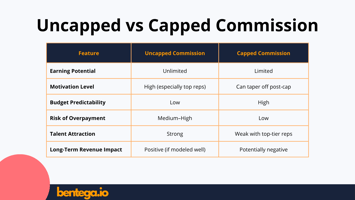
Capped versus uncapped commission
Capped versus uncapped commission is a design decision that can apply across several models.
A cap sets a maximum amount of commission that can be earned under the relevant plan terms. An uncapped structure allows commission earnings to continue as eligible performance increases.
Advantages of a cap
- Places an upper boundary on commission cost.
- Can provide greater cost certainty.
- May help manage unusual situations where very large transactions could produce payouts that are disconnected from the participant's actual influence.
Disadvantages of a cap
- Once the cap has been reached, the participant may have less financial reason to generate additional commissionable results within that period.
- A hard cap can weaken the relationship between additional performance and additional reward.
- It can create difficult edge cases when unusually large deals occur.
Advantages of uncapped commission
- Preserves the connection between additional eligible performance and additional earnings.
- Allows upside to continue beyond quota or other performance levels.
- Avoids a hard point where the commission incentive stops.
Disadvantages of uncapped commission
- Creates less certainty around maximum payout cost.
- Requires the underlying rates, margins and eligibility rules to remain economically sensible at high performance levels.
- Unusually large deals or windfalls may expose weaknesses in poorly defined plan rules.
Companies should consider deal size, margin, participant influence and unusual scenarios when deciding how earnings should behave at the upper end.
For a deeper treatment of the trade-off, read about capped versus uncapped sales commission.
Team-based, split or hybrid commission
Some sales motions cannot credibly attribute the entire result to one person.
Team-based, split or hybrid structures allow credit or commission to be shared across participants, or combine more than one measure or payout mechanism.
For example, two sellers may receive defined portions of credit for the same opportunity, or an individual component may be combined with a team component.
Advantages
- Can reflect genuinely collaborative sales processes.
- Allows multiple contributors to participate in the incentive outcome.
- Can align compensation with shared ownership where individual attribution would be artificial.
Disadvantages
- Unclear split rules can create disputes.
- Individual line of sight may weaken as more contributors or measures are added.
- More complexity does not automatically make the plan more effective.
Best fit
These approaches make the most sense where collaboration is genuinely required to produce the result and the business can define clear crediting rules.
If a plan needs several overlapping mechanisms simply to compensate for unclear ownership, the first problem to solve may be role and attribution design rather than commission complexity.
How to choose among the commission models
Comparing commission pay structures is easier when the discussion starts with operating conditions rather than a preferred formula.
Ask these eight questions before shortlisting a model.
1. What behaviour or outcome should the plan encourage?
Start with the result that matters.
New revenue, retained revenue, margin quality and shared team outcomes may call for different structures.
2. What can the participant genuinely influence?
The stronger the participant's control over the result, the more credible it is to link their pay directly to it.
When the result depends heavily on other teams or external factors, a purely individual commission model may create a weak connection between contribution and reward.
3. How clear is attribution?
Can the company identify who contributed to the result?
If attribution is straightforward, an individual model may work well. If selling is collaborative, split or team treatment may better reflect how value is created.
4. How stable are margins and deal values?
A simple revenue-based rate is easier to operate when deal economics are relatively consistent.
Wide variation in margin, discounting or contract value may justify a model that accounts for those differences.
5. How long is the sales and earning cycle?
Long cycles can affect income stability and when performance becomes measurable.
That may influence the balance between fixed and variable pay, whether a draw is appropriate and how the earning event is defined.
6. Is reliable quota, revenue, margin or retention data available?
Do not choose a measure that the business cannot produce consistently.
A profit-based model needs trustworthy margin data. A quota-dependent model needs credible quota and attainment data. A residual model needs a consistent definition of recurring or retained value.
7. Can managers and participants understand the calculation?
A model should be understandable enough to create a credible connection between performance and reward.
If the logic is so complicated that participants cannot determine why outcomes differ, the structure may be harder to operate regardless of how sophisticated it appears.
8. Can the process administer the model consistently?
Consider eligibility, effective dates, splits, exceptions and approvals.
The structure should be operationally workable, not just attractive on a design document.
Once you have shortlisted a model, use the commission structure design guide for the broader work of defining objectives, eligibility, measures, rates, thresholds and governance.
If you need to understand how those rules connect to calculation, review, approval and payout status beyond model selection, see the full sales commission process.
Choosing the model is only the first step
Selecting a commission model establishes the basic relationship between performance and variable pay. It does not finish the plan.
The next step is to document the exact operating rules: who is eligible, what counts, which rates apply, when rules become effective, how credit is assigned, how exceptions are handled and how results move through review and approval.
If the resulting structure becomes difficult to administer through spreadsheets and disconnected review steps, explore Bentega's sales commission software as a secondary next step.
Bentega helps companies manage plan rules, calculations, review, approvals, adjustments and payout visibility through one governed commission process.
Explore more
- Sales commission structure guide
- Sales commission guide
- SaaS Sales Commission Structures
- SDR commission structure
- Uncapped vs capped commission
- How to Design a Sales Commission Structures for Small Businesses
- Tiered commission structure example
- Sales commission guide template