A meeting appears in the calendar. The SDR counts it toward target. The account executive opens the notes and discovers that the company is outside the target market and the contact has no relevant need.
Was the SDR's work successful? The compensation plan needs an answer before the monthly review, not after two teams have interpreted the same meeting differently.
An SDR commission structure defines the outcomes that earn variable pay, the evidence required and how those outcomes become a payment amount. Its central challenge is to reward useful pipeline contribution without making the SDR responsible for every event between first contact and a closed deal.
Last updated: September 2, 2026

What should an SDR commission plan reward?
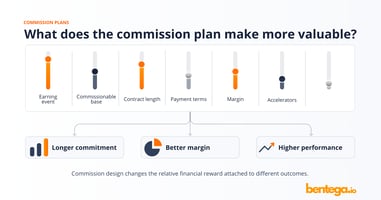
Start with an outcome the SDR can meaningfully influence and the next team can use. That could be a held, qualified meeting or an accepted opportunity. A booked appointment, an SQL and a closed-won deal are not interchangeable.
| Event | What it establishes | What still needs checking |
|---|---|---|
| Meeting booked | An appointment exists | Attendance, fit and qualification |
| Meeting held | The conversation took place | Whether the prospect and need meet the agreed criteria |
| Qualified meeting | The held meeting satisfies documented requirements | Whether an opportunity is accepted under the next-stage rules |
| Sales-qualified lead, or SQL | The lead meets the company's SQL definition | The definition itself; SQL does not universally mean a meeting |
| Accepted opportunity | The designated reviewer accepts a qualifying opportunity | Evidence, ownership and any required next action |
| Closed-won opportunity | The subsequent sale reaches the defined closed-won event | Attribution and the SDR's degree of influence over the result |
Choose precise event names in the plan and source data. If your business calls an accepted opportunity an SQL, document that convention rather than assuming everyone shares it.
For the broader relationship between base salary, target variable pay and role design, see the sales compensation guide.
Compare four SDR incentive approaches
Payment for held, qualified meetings
This keeps the reward close to the SDR's work. The plan can exclude no-shows, duplicates and clearly unsuitable prospects using agreed criteria.
The risk is rewarding conversations that technically qualify but create little useful pipeline. Review downstream acceptance and conversion patterns as diagnostic evidence rather than silently changing the earning rule after the event.
Payment for accepted opportunities
Here, a defined handoff must be accepted before it earns commission. This can connect the incentive more closely to usable pipeline.
It also gives the accepting team influence over the SDR's earnings. Acceptance needs objective criteria, a review deadline, a reason for rejection and a way to resolve disagreements. An AE's preference alone should not determine whether an otherwise qualifying opportunity counts.
A combination of meeting and opportunity incentives
A hybrid can reward both the initial qualified conversation and a stronger accepted handoff. State whether those are deliberately separate rewards for the same prospect or alternatives that must not be counted together.
The plan becomes harder to explain if each event triggers several additional multipliers. Keep the additional rules proportionate to the problem they solve.
A closed-won contribution bonus
A later bonus can recognize the SDR's contribution when an attributed opportunity becomes revenue. It should account for the sales cycle and the fact that pricing, competition, product fit and AE execution also affect the outcome.
If most variable pay depends on closed-won deals, the SDR may have too little control or wait too long to understand the reward. Consider whether a smaller secondary bonus is more appropriate than making closed revenue the main earning condition.
Build the qualification and acceptance rules first
A rate is easy to calculate after the earning event is clear. The difficult part is specifying what counts.
A practical qualification record can include:
- Account fit: the company meets the target-market criteria stated in the plan.
- Relevant contact: the participant has an appropriate role in the buying process.
- Confirmed need: the conversation identifies a problem relevant to the offering.
- Meeting evidence: the agreed participants attended and the outcome is recorded.
- Next action: the handoff includes a defined next step where required.
- Attribution: the originating SDR and relevant source records are identified.
- Uniqueness: duplicate meetings or recycled opportunities follow a stated rule.
Use criteria suited to the actual sales motion. Requiring a fully established budget at an early discovery stage, for example, may reject useful opportunities if the SDR's job is to develop interest before a formal buying process exists.
Define a review service level. An illustrative policy might ask the AE to accept or reject a handoff within three business days, with a reason, and route overdue decisions to the manager. The deadline is an example, not a market standard.
Example: an SDR plan that reconciles to $75,000 OTE
The following US-dollar example is fictional and before tax. It is a design illustration, not a salary or commission benchmark.
Assume a fully ramped employee works the complete plan year. The plan has:
- Annual base salary of $55,000.
- Target annual variable pay of $20,000.
- Annual OTE of $75,000.
- A quarterly target of 40 held, qualified meetings.
- A quarterly target of 10 accepted opportunities generated from eligible SDR-sourced meetings.
- $100 for every eligible held, qualified meeting.
- A separate $100 for every eligible accepted opportunity.
- No accelerators, caps, closed-won bonuses or other incentives in this example.
An accepted opportunity may intentionally earn both payments: $100 for the qualifying meeting and another $100 for acceptance. Both milestones need separate evidence. Each event counts once under the plan's attribution rules.
At quarterly target:
40 qualified meetings × $100 = $4,000
10 accepted opportunities × $100 = $1,000
Quarterly target variable pay = $4,000 + $1,000 = $5,000
Across four quarters:
Annual target variable pay = 4 × $5,000 = $20,000
Annual OTE = $55,000 + $20,000 = $75,000
The targets imply one accepted opportunity for every four qualified meetings, a 25% planning ratio. This assumes a steady flow of meetings and acceptances across period boundaries; it is not a benchmark or necessarily the conversion rate of one quarter's meeting cohort.
| Quarterly outcomes | Qualified-meeting commission | Accepted-opportunity commission | Total variable pay |
|---|---|---|---|
| 30 qualified meetings; 6 accepted opportunities | $3,000 | $600 | $3,600 |
| 40 qualified meetings; 10 accepted opportunities | $4,000 | $1,000 | $5,000 |
| 50 qualified meetings; 15 accepted opportunities | $5,000 | $1,500 | $6,500 |
The outcomes can move independently. Forty qualified meetings and six accepted opportunities would produce $4,600, not the $5,000 target amount.
This plan earns commission per eligible event, not only after target is reached. Approved amounts enter the monthly downstream payment cycle; quarterly and annual targets provide the performance reference. Events belong to the period in which each milestone occurs, so acceptance in a later month or quarter is recorded then rather than silently backdated. The acceptance record stays linked to the originating qualified meeting and credited SDR, even when that meeting occurred in a previous period.
Read the OTE guide for the distinction between target earnings and guaranteed compensation.
Document the event before setting the rate
Download the sales commission guide and template to record qualification criteria, acceptance ownership, attribution, rates and payment timing in one plan.
How to add an accelerator without breaking the example
An accelerator is optional. Add it only after the ordinary plan is understandable and the extra payout fits the economics.
Suppose a separate version of the example pays $150 per held, qualified meeting after the first 40 in a quarter. The first 40 still earn $100 each. Accepted opportunities continue to earn $100 each.
At 50 qualified meetings and 15 accepted opportunities:
(40 × $100) + (10 × $150) + (15 × $100) = $7,000
That is $500 more than the non-accelerated example. At exactly 40 meetings, the meeting component remains $4,000. The higher rate is not applied retroactively to all meetings.
This is an alternative plan version, not an extra bonus to add on top of both earlier calculations. See the tiered commission explanation for marginal versus retroactive treatment.
Decide what happens to no-shows, duplicates and delayed decisions
Write the difficult cases while nobody's earnings are at stake.
| Situation | Decision the plan needs |
|---|---|
| Prospect does not attend | Does the event remain ineligible until a qualifying meeting is actually held? |
| Meeting is rescheduled | Which event ID prevents two payments for one conversation? |
| Several contacts attend one meeting | Does this count as one meeting or several eligible events? |
| Existing customer or open opportunity | Is this eligible sourcing, expansion support or excluded duplicate work? |
| Two SDRs contribute | Is credit shared, assigned to one owner or handled through separate defined roles? |
| AE rejects the opportunity | Which criterion failed, and who reviews a disagreement? |
| Acceptance is late | In which period is commission recorded, and how is the delay resolved? |
| Opportunity later closes lost | Does the earlier milestone remain earned under its original conditions? |
A later lost sale does not by itself prove that an earlier qualified meeting was invalid. Do not introduce an undisclosed clawback just because a downstream outcome was disappointing.
Payment timing, deductions and any recovery provisions need appropriate contractual and local review. The process examples here are not jurisdiction-specific employment advice.
Account for ramp, territory and source differences
A fully ramped outbound SDR and a new hire handling inbound requests may face different opportunity levels. Comparing raw meeting totals can obscure those differences.
Decide how targets and eligibility work for new hires, part-time schedules, leave and territory changes. If targets are prorated, explain whether target variable pay and accelerator thresholds also change. Simply reducing quota while leaving every other rule untouched can change the effective earning opportunity.
For inbound and outbound work, examine the contribution required, source quality and available volume before choosing identical rates. Separate plans may be justified, but the distinction should be explainable from the work rather than negotiated through recurring exceptions.
These are plan-design decisions. Do not infer salary fairness or appropriate market pay from the fictional amounts above.
Review pipeline quality without making the plan unpredictable
Use downstream outcomes to learn whether the plan rewards useful work. Review acceptance rates, rejection reasons, progression, duplicate rates and time to decision alongside activity volume.
Low conversion may indicate weak qualification. It may also indicate a product-fit problem, an overloaded sales team or changes in the target market. Investigate the pattern before assigning responsibility to the SDR.
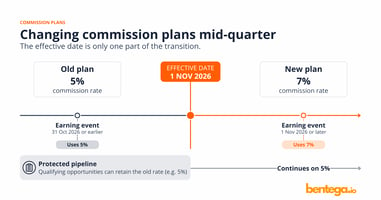
When evidence supports a change, define the new rules and effective date before the affected work occurs. Frequent retroactive interpretation makes earnings harder to anticipate and the plan harder to trust.
For the rest of the customer journey, see the SaaS commission structure guide.
How Bentega supports SDR incentive administration
SDR incentives can combine fixed event payments, targets and bonuses while using a different earning event from AE commissions. Bentega treats these as part of a broader incentive compensation process rather than requiring every role to be paid on closed revenue.
Teams can configure incentive Components, define participants and effective dates through Compensation Plans, import performance records through API, Excel or CSV, and review calculated results through customer-defined approval workflows. Employees and authorized managers can see the calculation and adjustment context relevant to their roles.
Bentega does not decide whether a prospect is genuinely qualified. Your team defines the criteria, produces the evidence and resolves attribution decisions. Software supports consistent administration of those decisions; it does not replace them or execute payroll settlement.
Explore the Bentega product if multiple SDR and AE plans are becoming difficult to calculate, review and explain together.
Frequently asked questions
Should SDRs be paid for booked or held meetings?
The plan can use either, but the distinction changes what is rewarded. Held, qualified meetings add attendance and quality conditions. Booked-meeting incentives need particularly clear handling of no-shows, cancellations and duplicates. Choose the event intentionally and name it accurately.
Is an SQL the same as a qualified meeting?
Not necessarily. SQL is a qualification stage defined by the business. A meeting is an activity or event. If your company uses one as evidence for the other, write down the relationship and the acceptance criteria.
Should SDR commission depend on closed-won revenue?
It can include a closed-won contribution bonus, but consider the SDR's influence, attribution and time to outcome. A plan based mostly on events far outside the SDR's control can weaken the connection between effort and earnings.
How do you check whether an SDR plan reaches OTE?
Calculate every variable component at its stated target, using the same annual period, and add base salary. Include conversion and acceptance assumptions explicitly. Do not rely on an unspecified discretionary bonus to fill a gap.
Make the handoff worth rewarding
A useful SDR plan does not stop at the meeting count. It defines the handoff the next team needs, makes the reward understandable and gives reviewers enough evidence to apply the rules consistently.
Keep three checks in the plan:
- Name the qualifying event and the person responsible for acceptance.
- Reconcile every target component to the advertised OTE.
- Define attribution and period rules before exceptions affect earnings.
Download the sales commission guide and template to build those definitions into the plan before the next quarter starts.