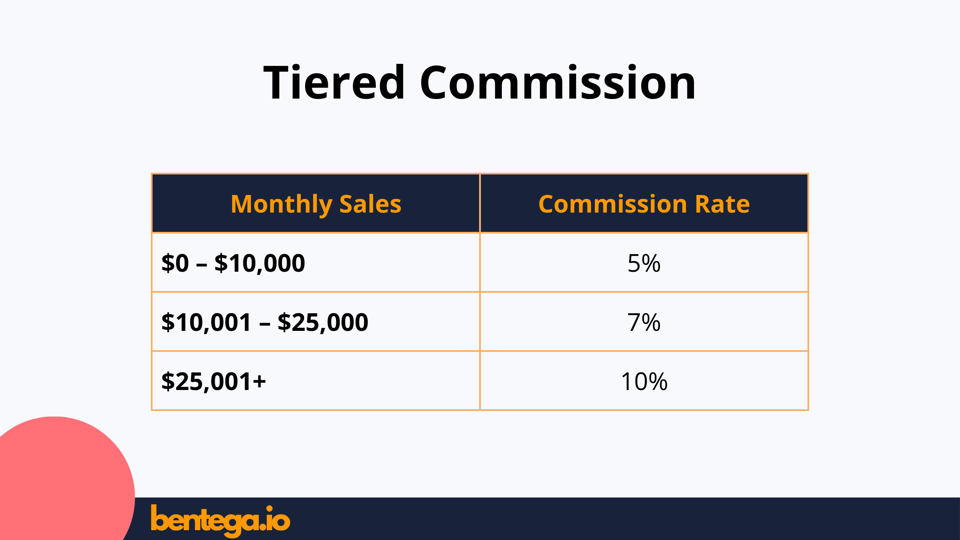
Two commission plans use the same rates: 5%, 7% and 10%. The same salesperson closes $60,000 of eligible sales in a month.
One plan pays $5,050. The other pays $6,000.
Neither result is necessarily a calculation error. The difference is whether a higher rate applies only to sales inside its band or retroactively to all eligible sales in the month.
A tiered commission structure changes the applicable rate across defined levels of performance. To calculate it correctly, you need the bands, the measurement period and the rule for applying each rate, not just a list of percentages.
Last updated: 2 September, 2026.
Marginal and retroactive tiers are different mechanics
Marginal tiers, also called incremental tiers in this guide, apply each rate only to the portion of eligible sales within that band. Crossing a boundary does not change commission on earlier bands.
Retroactive tiers, sometimes called all-in tiers, apply the rate associated with the achieved performance band to all eligible sales in the specified period.
Terminology varies between plans and systems. The contract or plan document should describe the calculation explicitly rather than relying on a label alone.
Tiered rates can rise or fall. An increasing marginal rate is often described as an accelerator; a decreasing one as a decelerator. Neither automatically creates a payment cap. For broader design choices, see the sales commission structure guide.
The example: monthly sales bands of 5%, 7% and 10%
The following two fictional plans use US dollars before employee taxes. The rates are illustrations, not market benchmarks or recommended pay levels.
Both plans measure one salesperson's cumulative eligible sales within a calendar month. They use the same qualifying transactions and crediting rules, with no shared credit, cancellations, base salary or additional bonuses included in the calculation.
For the marginal version, the bands are:
| Portion of eligible monthly sales | Rate applied to that portion |
|---|---|
| First $10,000 | 5% |
| Amount above $10,000 and up to $25,000 | 7% |
| Amount above $25,000 | 10% |
For the retroactive version, the achieved monthly total selects one rate:
| Total eligible monthly sales | Rate applied to the entire monthly total |
|---|---|
| $0 through $10,000, inclusive | 5% |
| More than $10,000 through $25,000, inclusive | 7% |
| More than $25,000 | 10% |
These intervals cover cents as well as whole dollars. There is no gap between $10,000 and $10,001. Exactly $10,000 remains in the first retroactive band; exactly $25,000 remains in the second.
Calculation 1: marginal tiers pay $5,050
At $60,000 of eligible monthly sales, divide the amount between the bands:
| Band | Eligible amount in the band | Calculation | Commission |
|---|---|---|---|
| First $10,000 | $10,000 | $10,000 × 5% | $500 |
| Above $10,000 through $25,000 | $15,000 | $15,000 × 7% | $1,050 |
| Above $25,000 | $35,000 | $35,000 × 10% | $3,500 |
| Total | $60,000 | $500 + $1,050 + $3,500 | $5,050 |
Only the final $35,000 earns 10%. Reaching the highest band does not change the rate on the first $25,000.
For a non-negative eligible monthly sales amount, S, the formula is:
5% × min(S, $10,000) + 7% × min(max(S − $10,000, 0), $15,000) + 10% × max(S − $25,000, 0)
This example resets the sales total at the beginning of each calendar month. If your plan is quarterly or annual, define that period instead; the same transaction pattern can produce different results when the reset period changes.
Calculation 2: retroactive tiers pay $6,000
With $60,000 of eligible monthly sales, the retroactive version selects the 10% rate because the total is above $25,000.
It then applies that rate to the entire month's eligible sales:
$60,000 × 10% = $6,000
The difference from the marginal version is:
$6,000 − $5,050 = $950
The rates and sales are identical. The application rule accounts for the entire difference.
Want to model your own commission assumptions? Try the sales commission calculator to compare payout scenarios using different attainment levels and commission rules.
Test the boundaries, including cents
The following table calculates each complete monthly result and then rounds once to the nearest cent, with half cents rounded up. It does not round each band separately.
| Eligible monthly sales | Marginal commission | Retroactive commission |
|---|---|---|
| $9,999.99 | $500.00 | $500.00 |
| $10,000.00 | $500.00 | $500.00 |
| $10,000.01 | $500.00 | $700.00 |
| $25,000.00 | $1,550.00 | $1,750.00 |
| $25,000.01 | $1,550.00 | $2,500.00 |
| $60,000.00 | $5,050.00 | $6,000.00 |
The marginal result changes continuously before currency rounding. The retroactive result has a step when the monthly total enters a higher band, because earlier sales are repriced as well.
The identical displayed marginal amounts around a boundary do not mean the extra sales are ignored. A fraction of a cent is present in the unrounded calculation and disappears under the stated rounding rule.
Choose a rounding convention and apply it consistently. Rounding every transaction separately can produce a different total from calculating the cumulative monthly amount and rounding once.
How to handle a sale that crosses a tier
Suppose eligible sales stand at $9,000 and a new qualifying sale adds $3,000. The new monthly total is $12,000.
Under marginal tiers
The first $1,000 of the new sale completes the 5% band. The remaining $2,000 earns 7%:
($1,000 × 5%) + ($2,000 × 7%) = $190
The cumulative commission increases from $450 to $640.
Under retroactive tiers
The new monthly total selects 7%, applied to all $12,000:
$12,000 × 7% = $840
The previous cumulative commission was $9,000 × 5% = $450. The increase is therefore $390, including the effect of repricing earlier sales.
Do not describe the entire $390 as 7% commission on the new $3,000 sale. Part of it is a true-up on previous sales in the same period.
Calculate cumulatively when tiers use cumulative sales
A monthly plan should not accidentally restart its bands for each transaction.
With two $30,000 sales in one month, the marginal plan produces:
- After the first sale: $500 + $1,050 + $500 = $2,050.
- After the second sale: cumulative commission of $5,050.
- Increment attributable to the second sale: $5,050 − $2,050 = $3,000.
Applying the first three bands independently to each sale would produce $2,050 twice, or $4,100. That would be a different, transaction-level plan, not the monthly cumulative plan described here.
For the retroactive version, the first $30,000 total produces $3,000 and the $60,000 total produces $6,000. The second increment is $3,000.
If interim amounts have already been recorded, calculate the current cumulative result and reconcile it with amounts previously recorded for that same period. Source-data corrections, reversals and previously approved payments need their own review treatment; they should not be hidden inside an unexplained negative amount.
For the wider calculation workflow, see how to calculate sales commissions.
What does the $950 difference tell you about performance?
It tells you that the marginal example has a $950 lower commission cost at the specified $60,000 sales result.
The effective commission rates are approximately:
- Marginal: $5,050 ÷ $60,000 = 8.42%.
- Retroactive: $6,000 ÷ $60,000 = 10%.
It does not tell you which plan would generate more revenue, attract better candidates or produce a better return on incentive spending. Those claims require evidence about how outcomes change under the different plans.
A useful economic comparison should consider margins, transaction timing, discounts, cancellations and the actual response to the incentive. Keep a calculation comparison separate from a causal performance claim.
Tiers and accelerators are only one way to change the relative financial reward. Our guide to sales commission design levers compares them with contract, payment, margin, crediting and cap rules.
Questions to settle before using tiers
What earns credit toward a band?
Booked sales, collected cash, recurring contract value and margin are different measures. State the basis and when it becomes eligible. See the SaaS commission structures guide for subscription-specific choices.
Whose performance determines the rate?
Individual sales, team sales and company performance can produce different rates on the same transaction. If team performance selects the rate for individual commission, make that relationship explicit.
What happens when a sale is reversed?
A reversal can reduce the cumulative base and potentially change the selected retroactive tier. Define the calculation correction, approval process and treatment of amounts already earned or paid. Do not assume automatic payroll deductions are permitted.
How are plan changes handled?
Record effective dates and which sales remain under the earlier version. A change in the middle of a month should not silently apply a new rate schedule to all earlier transactions.
Where Bentega fits
Bentega supports incentive calculations through configured plan components, participant eligibility, approvals and calculation history. The important implementation step is to translate the intended tier mechanics into explicit rules and check the boundary cases against expected results.
Employees need to understand the basis and amount, not just see a final total. Bentega's employee portal provides access to relevant compensation information.
Review the Bentega product overview alongside the specific calculation and review requirements of your plan.
Frequently asked questions
What is a tiered commission structure?
It is a structure in which commission rates vary across defined performance levels. The plan must explain the qualifying measure, period and whether each rate applies marginally within its band or retroactively to all eligible performance.
Are tiered commission and accelerators the same?
Not exactly. An accelerator describes an increase in the applicable rate as performance rises. A tiered structure can implement that increase, but tiers can also have decreasing rates. The label does not specify whether the rate is marginal or retroactive.
What rate applies at exactly the threshold?
The plan must define it. In this article's retroactive example, exactly $10,000 uses 5% and exactly $25,000 uses 7%. The higher rates apply only when the total exceeds those boundaries.
Is the lower-cost tiered plan necessarily better?
No. Lower commission cost at the same assumed sales result is only a cost comparison. Judging the incentive plan also requires evidence about sales outcomes, customer quality, margins and behavior.
Test the rule, not just the headline rate
Before launching tiered commission, calculate a low result, each boundary, a crossing transaction and a reversal. Confirm that the employee, plan owner and reviewer can explain the same result.
Three rules prevent common misunderstandings:
- State whether tiers are marginal or retroactive.
- Define exact boundaries, the accumulation period and rounding.
- Separate a lower calculated cost from evidence of better incentive performance.
Start documenting those rules with the sales commission guide and template.