An annual incentive plan (AIP) is a structured variable pay plan that rewards employees for achieving defined performance goals over a yearly period.
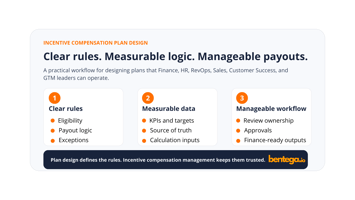
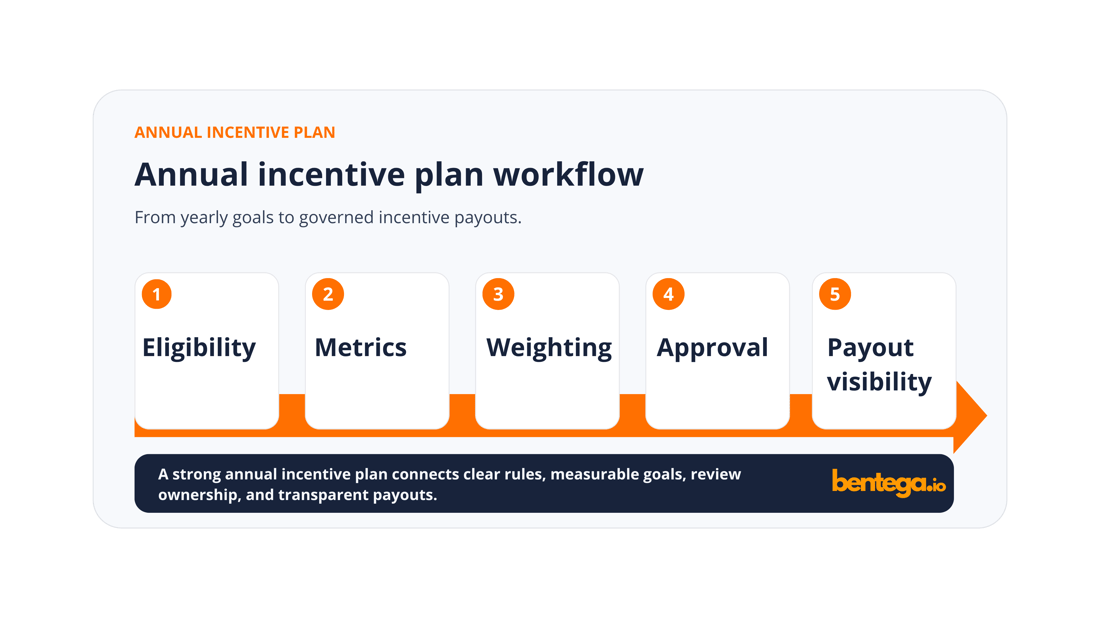
The plan normally defines who is eligible, which metrics matter, how performance is weighted, how payouts are calculated, who approves the result, and when the incentive is paid.
An AIP bonus is the payout produced by the plan. The annual incentive plan is the structure behind it.
This guide explains what an annual incentive plan means, how AIP bonuses work, how payouts can be calculated, and how to design a plan that is clear for employees and manageable for Finance and HR.
What does annual incentive plan mean?
An annual incentive plan, commonly shortened to AIP, is a compensation plan that pays variable compensation based on performance during a defined annual period.
The plan typically combines company, team or individual performance measures with a target incentive opportunity and defined payout rules.
In simple terms:
AIP = annual performance rules + payout opportunity + calculation logic + approval process
The resulting payout is often referred to as the AIP bonus.
Annual incentive plans are commonly used for managers, executives and other employees whose variable compensation is tied to business or functional performance over the year.
They can also be used across broader employee groups where the company wants to connect variable pay to measurable annual objectives.
How does an annual incentive plan work?
A typical annual incentive plan follows a relatively simple structure:
- The company defines who is eligible.
- A target incentive opportunity is established.
- Performance metrics and weightings are agreed.
- Threshold, target and maximum performance levels may be defined.
- Performance is measured across the plan year.
- Results are calculated after the measurement period.
- The outcome is reviewed and approved.
- The final incentive is paid according to the plan's payout rules.
The calculation can be simple or complex depending on the role.
A basic AIP may use one company-wide metric.
A more complex plan might combine:
- company revenue
- profitability
- team performance
- individual KPIs
- customer outcomes
- strategic objectives
The important part is not how many metrics are included. It is whether the employee can understand what drives the payout and whether the company can measure those inputs consistently.
Annual incentive plan vs bonus
A bonus is a form of variable pay. An annual incentive plan is the framework used to determine whether and how that bonus is earned.
The distinction is useful:
- Annual incentive plan: the rules, metrics, targets, weightings and payout logic
- AIP bonus: the actual variable-pay amount produced by the plan
- Annual bonus: a broader term that may describe either a structured incentive payout or a more discretionary year-end payment
Not every annual bonus is an AIP.
A structured annual incentive plan should define the performance period, eligibility, metrics and payout rules before the result is known.
That is different from a purely discretionary bonus that management decides to award after the year has ended.
For a broader overview of bonus design, payout logic and governance, see our bonus guide.
What should an annual incentive plan include?
A well-defined annual incentive plan should answer more than “how much is the target bonus?”
It should explain the full logic behind the payout.
Eligibility
The plan should define who participates.
That may depend on:
- role
- employment status
- start date
- business unit
- geography
- seniority
- plan assignment
Joiners, movers and leavers should also be addressed where relevant.
Performance period
The measurement period should be clear.
For most annual incentive plans, this is the financial or calendar year, but the plan should still define:
- start date
- end date
- treatment of partial-year participation
- treatment of plan changes during the year
Performance metrics
The plan should define which outcomes are rewarded.
Examples include:
- revenue
- EBITDA or operating profit
- gross margin
- customer retention
- NRR
- project delivery
- quality measures
- individual strategic objectives
The selected metrics should be relevant to the role and measurable from reliable data.
Weightings
Where several metrics are used, the plan should define how much each one contributes to the final payout.
For example:
- Company performance: 50%
- Team performance: 30%
- Individual performance: 20%
The weightings make the relative importance of the different objectives explicit.
Target incentive opportunity
The plan should define the target payout opportunity.
This is often expressed as a percentage of salary.
For example:
Base salary: €80,000
Target AIP: 15%
Target incentive opportunity: €12,000
The target amount is normally the payout associated with target-level performance, not automatically the maximum payout.
Thresholds, target and maximum
Some annual incentive plans use a performance curve.
For example:
- below threshold: no payout
- threshold performance: 50% payout
- target performance: 100% payout
- maximum performance: 150% payout
The exact relationship depends on the plan.
The important point is that the payout curve should be defined before performance is known.
Payout timing
The plan should state when the final incentive is paid.
This is normally after year-end performance has been measured and approved.
Timing should also take into account the company's normal payroll and approval process.
Approval
The final calculation may require review before payout.
Depending on the organisation, this could involve:
- manager review
- Finance
- HR
- compensation committee
- executive leadership
- board approval for certain populations
The approval path should be proportionate to the risk and complexity of the plan.
How is an annual incentive plan calculated?
For a plan with several weighted components:
Total calculated incentive = sum of (target incentive × component weight × component payout factor).
The payout factor comes from the plan’s payout rules. It may equal performance attainment in a linear plan, but thresholds, payout curves, or caps can produce a different result.
In practice, plans often combine several weighted metrics.
Consider this example. This example assumes a linear payout rule for every component: 110% attainment produces a 110% payout factor, with no thresholds, gates, or caps.
Base salary: €80,000
Target annual incentive: 15% of base salary
Target incentive opportunity: €12,000
Assume the plan uses:
- Company performance: 50%
- Team performance: 30%
- Individual performance: 20%
And actual performance is:
- Company metric: 110%
- Team metric: 100%
- Individual metric: 90%
The weighted performance result is:
(110% × 50%) + (100% × 30%) + (90% × 20%)
Which gives:
55% + 30% + 18% = 103%
The estimated payout is therefore:
€12,000 × 103% = €12,360
This is a simplified example.
A real plan may also include:
- payout thresholds
- caps
- performance gates
- payout curves
- metric-specific rules
- discretionary adjustments
- partial-year eligibility
- different payout factors for different performance ranges
Those rules should be visible in the plan before the payout is calculated.
Annual incentive plan examples
There is no universal AIP structure that works for every employee group.
The right design depends on the role, the business model and which outcomes the employee can meaningfully influence.
Example 1: Customer Success
A Customer Success leader might have:
- Target incentive: 10% of salary
- 40% NRR
- 30% renewal rate
- 20% customer health
- 10% individual strategic objectives
This structure combines customer retention with broader team and individual contribution.
The important question is whether the metrics are measurable and genuinely influenced by the role.
Example 2: Finance leader
A Finance leader might have:
- Target incentive: 15% of salary
- 50% company profitability
- 30% forecast and reporting objectives
- 20% strategic finance projects
This type of structure blends company performance with functional objectives.
Example 3: Sales manager
A Sales manager might have:
- Target incentive: 20% of salary
- 50% team quota attainment
- 25% revenue quality or margin
- 25% leadership or operational goals
This can align the manager with team performance while still recognising revenue quality and broader leadership responsibilities.
These are illustrative structures rather than universal recommendations.
The right metrics depend on the role, the business model and what the employee can actually influence and verify.
Common annual incentive plan types
Annual incentive plans can be structured in several ways.
Company performance plan
The payout is driven mainly or entirely by company-level performance.
Typical metrics may include:
- revenue
- profitability
- EBITDA
- cash flow
- growth
- strategic milestones
This approach creates strong alignment around shared company outcomes.
The trade-off is that individual employees may have limited influence over the final result.
Department or team plan
The incentive is based on functional or team performance.
Examples could include:
- Sales team attainment
- Customer Success retention
- Finance process improvements
- operational performance
- product delivery targets
This can create a stronger link between the participant's work and the measured outcome.
Individual KPI plan
The payout in an individual KPI-based incentive depends mainly on individual objectives. This can work where individual performance is measurable and genuinely attributable to the employee.
The risk is that highly individual plans can become difficult to govern consistently across larger employee populations.
Hybrid annual incentive plan
A hybrid plan combines company, team and individual performance.
For example:
- 50% company
- 30% team
- 20% individual
Hybrid plans are common because they allow the company to balance shared business outcomes with role-specific contribution.
What is the difference between an AIP and commission?
An annual incentive plan and a sales commission plan can both create variable compensation, but they usually operate differently.
Sales commission is commonly linked directly to specific commercial performance such as:
- sales revenue
- ARR
- gross margin
- bookings
- quota attainment
AIP payouts are typically based on a broader set of annual performance measures and may apply to roles outside Sales.
For example, a Finance leader might participate in an AIP based on profitability and strategic objectives without earning commission on individual transactions.
A company can also use both.
A Sales leader may have a commission-based incentive structure, while managers and executives participate in an annual incentive plan.
What is the difference between AIP and OTE?
OTE, or on-target earnings, describes the expected total earnings when an employee achieves defined target performance.
It commonly includes:
Base salary + target variable compensation
An AIP can be the variable compensation component inside an OTE structure.
For example:
Base salary: €100,000
Target AIP: €20,000
OTE: €120,000
The AIP explains how the €20,000 target incentive is earned.
OTE describes the total expected compensation at target.
What makes an annual incentive plan effective?
A good AIP is not simply a spreadsheet with several metrics and a final percentage.
It should make the relationship between performance and payout understandable.
There are several practical design principles worth considering.
Use metrics employees can influence
Employees should understand how their work contributes to the outcome.
A metric may be strategically important without being suitable for every role.
Keep the number of metrics manageable
Adding more metrics does not automatically create a better plan.
Too many measures can dilute focus and make the payout difficult to explain.
Define the payout curve before the year ends
Thresholds, target payouts, maximum payouts and caps should be clear before actual performance is known.
Otherwise the plan can become a retrospective bonus decision rather than an incentive plan.
Use reliable data
A metric should not become part of variable compensation unless the company can measure it consistently.
Data quality problems become compensation problems once money depends on the result.
Define exceptions early
Common edge cases should be considered before payout.
Examples include:
- employees joining mid-year
- internal role changes
- parental or other leave
- acquisitions
- reorganisations
- metric-definition changes
- business-unit transfers
Not every edge case needs a complicated rule, but leaving everything undefined until year-end creates avoidable disputes.
Annual incentive plan governance
The calculation is only one part of operating an AIP.
A well-governed process should also define who owns the plan, where source data comes from, how results are reviewed and when the payout becomes final.
A practical annual process might look like this:
- Approve the plan before the performance period.
- Confirm eligible participants.
- Define metrics, weights and payout rules.
- Track performance through the year.
- Validate final source data after period-end.
- Calculate preliminary payouts.
- Review exceptions and adjustments.
- Approve the final result.
- Send the approved payout downstream.
- Retain the calculation and decision history.
This becomes increasingly important as the company introduces:
- more employee groups
- different bonus structures
- multiple currencies
- several source systems
- manual adjustments
- approval requirements
- changes during the performance period
What looks like a simple annual bonus calculation can quickly become a cross-functional operating process.
Annual incentive plans for Finance, HR and GTM teams
Finance
Finance typically needs to understand:
- expected payout exposure
- the relationship between performance and cost
- which assumptions drive the calculation
- which exceptions have changed the result
- whether the final outcome has been reviewed and approved
This is especially important where payout curves create nonlinear cost at higher performance levels.
HR and People
HR typically focuses on:
- eligibility
- plan consistency
- communication
- employee understanding
- role changes
- fairness across comparable populations
A clearly documented plan makes it easier to explain why two employees may receive different payouts.
GTM leadership
GTM leaders typically focus on whether incentives support the right behaviour.
A plan can be mathematically correct and still encourage the wrong outcome. For example, a plan that rewards growth without considering customer quality, margin or retention may create tension elsewhere in the business.
The plan should therefore reflect the actual business objective rather than simply reuse whatever metric is easiest to calculate.
Common annual incentive plan mistakes
Making the plan too complicated
Complexity should have a clear purpose.
If employees cannot explain the basic payout logic, the plan is difficult to use as an incentive.
Changing metrics after performance is known
Retroactive changes undermine clarity and can create disputes.
Changes during the year should have clear ownership, effective dates and communication.
Using metrics that are difficult to verify
If the underlying performance result cannot be reproduced, the incentive calculation becomes difficult to defend.
Leaving eligibility unclear
Many payout disputes begin before the calculation.
The employee may not know whether they were eligible, which period applied, or how a role change affected participation.
Treating calculation as the entire process
A correct number still needs to be reviewed, approved, communicated and handled downstream.
That becomes increasingly important as the employee population and plan complexity grow.
How Bentega supports annual incentive plans
Annual incentive plans can become difficult to operate when plan rules, employee eligibility, performance data, calculations and approvals live in separate spreadsheets and systems.
Bentega is an incentive compensation management platform built to help teams manage variable compensation in a more structured workflow.
Teams can use Bentega to support incentive plan design, calculation logic, participant management, performance-based payouts, review and approval workflows, and employee visibility across commissions, bonuses and other forms of variable pay.
The value is not only calculating the final AIP bonus, but keeping the rules, data, calculations, reviews and payout process connected as the organisation grows.