

Sales commission can influence behavior by changing what counts, when an amount is earned, and how different commercial outcomes affect the payout.
The important distinction is that commission design does not guarantee a behavioral outcome. It changes the relative financial reward attached to different outcomes.
If a three-year commitment produces more commission than a month-to-month contract, the longer commitment becomes more valuable in the calculation. Whether that actually changes seller behavior still depends on the customer, the sales process, the size of the difference, and factors outside the commission formula.
That makes the useful design question:
What outcome do we want to make more valuable in the commission calculation, and what could go wrong if we do?
The answer can sit in many different parts of the plan: the commissionable base, the earning event, contract-length and payment-term modifiers, revenue-specific rates, margin rules, thresholds, accelerators, strategic weights, crediting rules and caps.
For the broader framework around eligibility, rates, targets and payout governance, start with Bentega's sales commission guide.
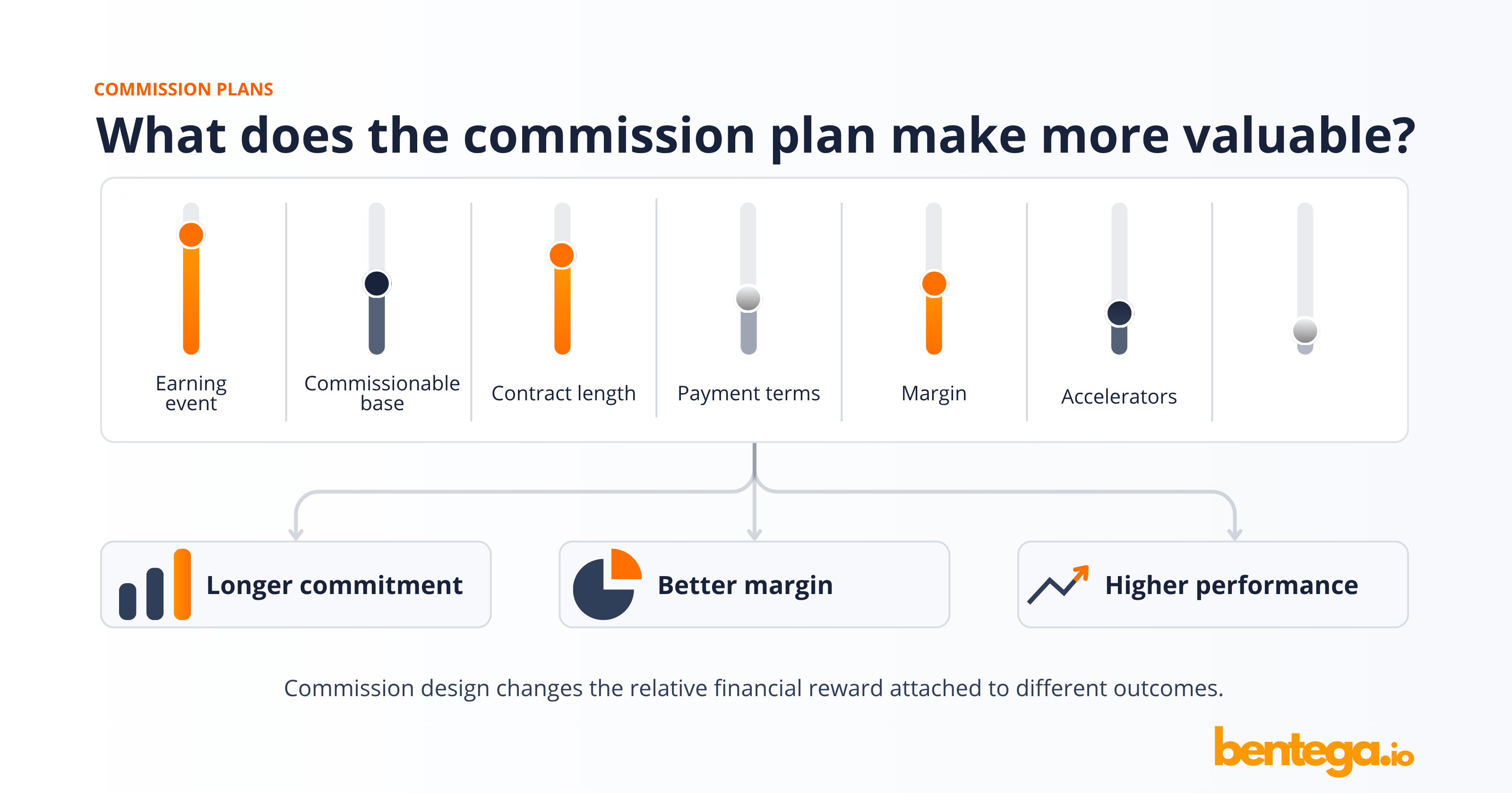
11 commission levers at a glance
These levers often interact.
A plan might use recurring revenue as the base, apply a contract-duration modifier, split credit between two people and then apply an accelerator after quota.
That is where seemingly simple rules stop being simple.
The order of operations, definitions and ownership all need to be explicit.
1. Choose the earning event
Intended priority: Completed, valid or durable transactions.
The first lever is deciding what event actually creates commission eligibility.
A company might use:
- A qualifying contract signature.
- Customer activation.
- Invoice issuance.
- Receipt of customer payment.
These events are not interchangeable.
Suppose an eligible transaction has a $50,000 commissionable base and a 5% rate.
The calculated commission is:
$50,000 × 5% = $2,500
Under a signature-based rule, the $2,500 may be earned when the qualifying contract is signed.
Under an activation-based rule, the same calculation may only become earned once the agreed activation conditions are met.
Under a collection-based rule, commission may depend on eligible customer payments actually being received.
Trade-off: The later the earning event sits in the commercial process, the further the reward can move from the seller's own work. Implementation delays, invoice administration or customer collections may be partly outside the seller's control.
That does not automatically make an earlier event better. It means the company needs to decide what the commission is actually intended to recognize.
Control: Define the qualifying event precisely, identify the system and timestamp that prove it happened, and keep the earning event separate from the date an approved commission is later processed for payment.
The distinction is particularly important in recurring-revenue businesses. Our SaaS sales commission guide goes deeper into signature, activation, collection and subscription-specific measures.
2. Choose the commissionable base
Intended priority: Decide which economic outcome the seller sees rewarded.
Changing the commissionable base can have a bigger effect than changing the headline rate.
A commission arrangement might use:
- Eligible bookings.
- Annual recurring revenue.
- Contract value.
- Collected revenue.
- A defined gross-profit amount.
Suppose a contract has $120,000 of eligible annual recurring revenue, but only $90,000 has been collected at the point being measured.
At the same 5% rate:
$120,000 × 5% = $6,000
$90,000 × 5% = $4,500
Neither calculation is inherently more correct. They answer different questions because they reward different bases.
Trade-off: Problems arise when the bases are poorly normalized or overlap. A salesperson might receive commission on committed contract value and then unintentionally receive another commission on the same value when it appears as recurring revenue or collected cash.
Control: Define one basis for each component, the period it covers, and how it interacts with quota credit and other incentives.
Do not treat ARR, ACV, contract value, invoiced revenue and collected revenue as alternative names for the same thing.
3. Apply a contract-length modifier
Intended priority: Make a longer contractual commitment more valuable in the payout calculation.
One way to do this is to start with a normalized annual value and then apply an explicit duration factor.
Consider this illustrative policy:
- Normalized eligible annual recurring revenue: $120,000.
- Commission rate: 5%.
- Base commission before the duration factor: $120,000 × 5% = $6,000.
The company then defines these factors:
These factors are illustrative policy choices, not market standards.
The important detail is what the factor changes. Here, the company first calculates commission from the normalized annual base and rate, then applies a duration factor to that commission.
It is not quietly changing the rate or redefining ARR.
Trade-off: Contract duration can easily be counted twice.
If the commissionable base has already been reduced to reflect a six-month commitment and a 0.5 duration factor is then applied again, the shorter agreement may be penalized twice.
There can also be a commercial conflict. A longer contract may earn more commission even when the customer has a legitimate reason to prefer a shorter commitment.
Control: Define the normalized base first, then state exactly where the duration factor enters the formula. Test short and long contracts before launch and check how the rule affects quota credit separately from payout.
4. Reward preferred invoicing or payment terms
Intended priority: Make certain billing or cash-timing outcomes more valuable.
This lever needs careful language because several events are often mixed together.
A contract can specify annual upfront billing without the invoice having been issued yet.
An invoice can be issued without the customer having paid it.
And customer payment can be received without that receipt necessarily being the event that earns commission under the arrangement.
Suppose the ordinary calculated commission on an eligible deal is $6,000.
A company could define an illustrative rule under which a qualifying annual-upfront billing schedule receives a factor of 1.10:
$6,000 × 1.10 = $6,600
The factor changes the calculated payout. It does not prove that $120,000 of cash has arrived.
A different arrangement could instead make confirmed eligible payment receipt the qualifying condition. That is a different rule.
Trade-off: A seller may push the preferred payment term even where it creates customer friction or requires a larger commercial concession.
An upfront billing incentive can therefore interact with discount authority, customer preference and renewal economics.
Control: Define whether the rule looks at the contracted billing schedule, invoice issuance or confirmed customer receipt. Identify the source for that event and avoid using “upfront payment” loosely when the rule actually means “upfront invoicing.”
5. Use different rates for recurring and non-recurring revenue
Intended priority: Change the relative reward between durable recurring revenue and one-time revenue.
A SaaS company may value both subscription revenue and implementation work but choose to reward them differently.
Assume:
- $100,000 of eligible recurring revenue at 5%.
- $20,000 of eligible implementation or service revenue at 1%.
The calculation is:
$100,000 × 5% = $5,000
$20,000 × 1% = $200
Total calculated commission = $5,200
The recurring component is more valuable in the commission calculation, while the service component still receives a defined reward.
Trade-off: A lower rate on implementation or services may lead sellers to under-emphasize work that is commercially necessary for the customer.
Weak revenue definitions create another problem. If the categories affect pay, there is an incentive to classify revenue into the better-paid category where the rules leave room for interpretation.
Control: Define each revenue category, its source data and the treatment of mixed contracts. Finance, RevOps and Sales should be able to classify the same transaction the same way.
If you are deciding how these levers fit into a complete arrangement, the Sales Commission Structure guide covers the broader design framework.
6. Make margin and discount effects visible
Intended priority: Make revenue quality or defined gross profit more important in the commission calculation.
A revenue-only commission treats two deals with the same eligible revenue equally even if their specified delivery costs are very different.
A gross-profit basis changes that.
For example:
- Eligible sales: $100,000.
- Specified cost of sales: $70,000.
- Defined gross profit: $30,000.
- Commission: 10% of gross profit.
Commission:
$30,000 × 10% = $3,000
If the seller gives a 10% discount while the specified costs remain $70,000:
- Eligible sales fall to $90,000.
- Gross profit falls to $20,000.
- Commission becomes $20,000 × 10% = $2,000.
That makes the discount more expensive to the seller than it would be under many revenue-only arrangements.
Trade-off: That does not mean the seller will necessarily make better pricing decisions.
They may reject a discount the company considers strategically justified. They may also be affected by delivery-cost inputs they cannot meaningfully influence.
Control: Define the gross-profit basis, cost source, treatment of estimates and later corrections. Sales needs enough visibility to understand which inputs affect the payout.
The full calculation, including cost changes after the initial result, is in our gross-margin commission guide.
7. Use thresholds and gates for minimum conditions
Intended priority: Require a minimum level of performance or a separate qualifying condition before commission applies.
Three terms are often mixed together here.
A quota is a performance target.
A threshold is a boundary that changes whether or how commission is earned.
A gate is a separate condition that must be satisfied.
They do not have to be the same number or rule.
Suppose a monthly arrangement has:
- $100,000 quota.
- $50,000 threshold.
- 5% commission only on eligible sales above the $50,000 threshold.
At $40,000, commission is $0.
At $60,000:
($60,000 − $50,000) × 5% = $500
That is one threshold design.
A different arrangement might pay from the first eligible dollar once the threshold is crossed. That would create a very different result and a much larger step at the boundary.
A gate works differently again. A $3,000 calculated commission might only become eligible if the underlying contract has received the required commercial approval or met a stated minimum-margin condition.
Trade-off: Hard boundaries can create strange incentives around timing. A transaction just above the line can suddenly become much more valuable than one just below it, depending on the design.
They can also become demotivating if participants spend much of the period far from the point where additional performance starts affecting pay.
Control: State exactly what happens below, at and above the boundary. Test the edge cases and distinguish performance targets from minimum earning conditions.
Do not assume that every quota-based commission arrangement pays nothing before quota.
8. Use accelerators to reward performance above target
Intended priority: Increase the marginal reward for additional performance after a defined level.
Suppose an annual arrangement pays:
- 5% on the first $100,000 of eligible sales.
- 8% on eligible sales above $100,000.
At $125,000:
($100,000 × 5%) + ($25,000 × 8%) = $7,000
That is a marginal accelerator. Only the $25,000 above the threshold receives 8%.
A retroactive rule could instead apply a higher rate to a broader amount after the boundary is crossed.
That distinction is not a detail. It changes the payout.
Trade-off: Poorly defined intervals create calculation errors, particularly around exact thresholds and transactions that cross several bands.
Very steep accelerators also increase payout exposure at high attainment and may make the timing of deals around a period boundary more valuable.
Control: Define whether rates are marginal or retroactive, the measurement period, exact boundaries, reset rules and rounding.
Our tiered commission example works through both methods and tests the boundaries.
9. Weight strategic products, customer types or markets
Intended priority: Make a specific commercial priority temporarily or permanently more valuable.
This can be done through a higher rate, a multiplier or a separate short-term incentive.
Suppose the ordinary commission on an eligible transaction is 5%.
A $20,000 standard product sale produces:
$20,000 × 5% = $1,000
If a defined strategic product has a 7% rate:
$20,000 × 7% = $1,400
The strategic product now carries $400 more commission at the same eligible sales value.
Another company might keep the main commission unchanged and introduce a time-limited SPIF for the priority instead.
Those are different mechanisms.
Trade-off: The seller may steer a customer toward the better-paid product, customer type or market even when another option is a better fit.
And if the strategic weighting remains in place long after the underlying priority has changed, the commission arrangement can start pulling against the current strategy.
Control: Define the eligible products or segments, owner, effective dates and interaction with the core commission arrangement. For temporary incentives, set a clear start and end date.
10. Design crediting and splits to influence collaboration
Intended priority: Recognize different contributions to a sale without leaving ownership to negotiation after the result is known.
Sales credit, split commission pools and separate role incentives are different mechanisms.
Take one $100,000 eligible transaction with a 5% commission pool.
The pool is:
$100,000 × 5% = $5,000
If the company deliberately splits that pool 60/40:
- Rep A receives $5,000 × 60% = $3,000.
- Rep B receives $5,000 × 40% = $2,000.
Total commission remains $5,000.
That is different from dividing the $100,000 sales basis between the participants and applying different individual rates.
It is also different from paying the primary seller in full and adding a separate specialist overlay.
Trade-off: If too many people receive credit, total incentive cost can grow without anybody being clear about who actually owns the commercial outcome.
Vague role boundaries create the opposite problem. Teams start debating credit after a deal closes.
Control: Decide which contribution is being recognized, who owns the source record and when ownership becomes fixed. Also define whether a shared rule affects quota credit, commission payout or both.
Our split commissions and sales crediting guide compares shared pools, divided sales bases and overlays with worked examples.
11. Use caps and other payout guardrails deliberately
Intended priority: Limit or reshape payout exposure under defined circumstances.
A cap puts a maximum on a specified commission component.
Suppose a quarterly arrangement pays 10% of eligible sales with a $75,000 cap.
At $750,000 of eligible sales:
$750,000 × 10% = $75,000
The cap has been reached.
Another $10,000 of eligible sales would ordinarily create:
$10,000 × 10% = $1,000
But under the capped component, it creates $0 of additional commission because the maximum has already been reached.
That is what the cap changes. It does not prove that the underlying $75,000 calculation was accurate or commercially sensible.
Trade-off: Once the cap is reached, the marginal commission incentive from that component disappears.
That does not allow us to predict what the seller will do next. But the financial reward for the next eligible sale has clearly changed.
A company concerned about unusually large payouts could also consider a predefined review point, an exceptional-deal rule or a lower marginal rate above a certain level. Those are different mechanisms and need their own rules.
Control: Define which component is capped, the amount, measurement period, reset treatment and what happens to adjustments or corrections. Do not introduce an informal cap after seeing a payout that management dislikes.
The capped versus uncapped commission guide compares the calculation and cost implications in more detail.
Combining commission levers is where the real design work starts
Most commission arrangements use more than one of these levers.
That is normal. It is also where ambiguity starts to compound.
Consider the contract-length example again:
$120,000 eligible annual recurring revenue × 5% = $6,000
Then apply the six-month duration factor:
$6,000 × 0.5 = $3,000
The factor changes the calculated commission.
If instead the arrangement reduces the commissionable base to $60,000, the immediate payout happens to be the same:
$60,000 × 5% = $3,000
But the policies are not necessarily equivalent.
If the commissionable base is also used for quota attainment, accelerators, caps or split credit, reducing the base can affect all of those calculations too. Applying a factor only to the commission may not.
So when several levers are combined, write down the sequence:
- Which amount is the commissionable base?
- What counts toward quota?
- Which rate applies?
- Which modifier applies to which quantity?
- When are thresholds or accelerators evaluated?
- When are splits applied?
- Where does a cap sit in the sequence?
A spreadsheet can make two formulas look almost identical while hiding very different policy decisions.
What to test before introducing a new lever
Before adding another rule, run a few cases through it.
Not just the expected deal.
Test a low result, the exact boundary and something just above it. Test a short contract and a long one. A discounted deal. A split deal. A cancellation or correction. And, where relevant, a very large transaction.
Then ask five basic questions:
- Can the seller explain what outcome earns more and why?
- Can RevOps identify the source data needed to calculate it?
- Can Finance explain the cost difference without assuming a behavioral outcome?
- Can the manager deal with an exception without inventing a new rule?
- Can the company still reconstruct which rule applied after the arrangement changes?
If the answer to several of those is no, the extra sophistication probably needs more work before it goes into the commission arrangement.
The sales commission guide and template can be used to document the final eligibility, calculation, timing and exception rules.
Where Bentega fits
Deciding what a commission rule should be is only part of the work.
The operational difficulty usually starts when several of these rules have to be applied at the same time, across different employees, effective dates, transactions and approval periods.
Bentega helps teams operationalize defined incentive rules across commission and broader variable pay. That includes configurable calculation logic such as thresholds, tiers, accelerators, caps, crediting, splits, recurring rules and margin logic, together with source data, exception review, approvals, employee visibility and change history.
The aim is to make it easier to apply the same defined rules consistently, review exceptions and understand how the resulting payout was calculated.
Key takeaways
Commission design can influence what becomes relatively more valuable to a seller, but it cannot guarantee a behavioral outcome.
A few distinctions are worth keeping clear:
- The commissionable base defines the value the calculation starts from.
- The rate determines how that value converts into commission.
- A modifier should state exactly which quantity it changes.
- The earning event is different from internal approval and downstream payment timing.
- Thresholds, accelerators, splits and caps can interact, so the order of calculation matters.
Do not add a rule simply because it sounds strategically aligned.
The better test is whether you can describe exactly what changes in the calculation, show the result with a few examples, explain the downside, and identify who owns the data and exceptions.
If you can do that, you have something that can actually be operated.