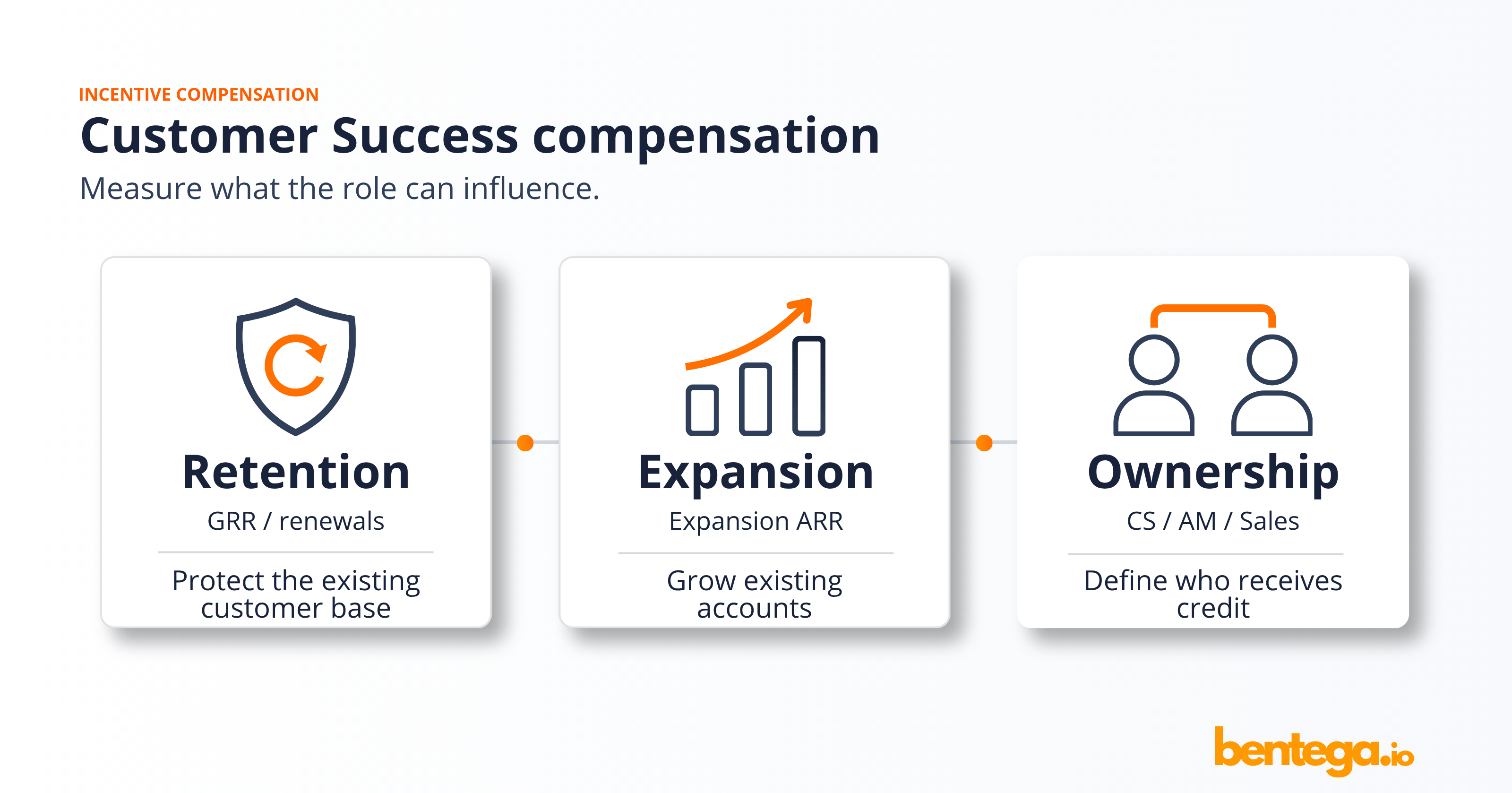
Customer Success compensation works best when the variable pay reflects outcomes the role can reasonably influence.
For a commercially accountable CSM, that may include retention, renewals or expansion. For a role focused primarily on adoption, support or customer enablement, directly tying pay to revenue outcomes may be much harder to justify.
The important design question is therefore not simply whether Customer Success should earn commission or bonus but rather:
What does this role actually own, how will that outcome be measured, and how does performance turn into variable pay?
A Customer Success compensation plan should make those decisions explicit before the measurement period begins.
For broader principles around base pay, variable pay, targets and OTE, see the Sales Compensation guide.
Should every Customer Success Manager have variable compensation?
No.
Customer Success roles vary considerably between companies.
Some CSMs own commercial renewals, negotiate expansion and carry explicit revenue responsibility. Others focus on onboarding, adoption, relationship management or customer outcomes while an Account Manager, Account Executive or renewal specialist owns the commercial transaction.
Those roles should not automatically receive the same compensation plan.
A useful starting point is to separate three questions:
If the CSM is primarily responsible for adoption but has little influence over pricing, renewal negotiation or expansion, a direct expansion commission may create a mismatch between accountability and control.
A commercially accountable CSM may be different. If the role genuinely owns retention and contributes directly to expansion, those outcomes can form part of the variable compensation structure.
This does not mean revenue metrics are always preferable to adoption or customer-health measures. The correct metric depends on the role, the company's operating model and the quality of the underlying data.
Decide what Customer Success can actually influence
Retention and expansion are attractive compensation metrics because they connect Customer Success to recurring revenue.
But both are also influenced by decisions outside Customer Success.
Customer fit may have been determined during qualification and sales. Pricing and contract terms may have been negotiated by Sales. Product reliability, implementation quality and support may materially influence the customer's decision to stay.
The plan therefore needs to distinguish between commercial accountability and simply being involved in the customer relationship.
A CSM compensation plan might use:
- gross revenue retention for protecting an existing customer base;
- eligible expansion ARR for growing that base;
- renewal completion where the role owns the renewal process;
- adoption or onboarding measures where revenue ownership sits elsewhere;
- a combination of metrics when the role has genuinely mixed responsibilities.
The more outcomes included, the more important it becomes to define exactly what each measure means and where its data comes from.
For general commission concepts such as earning rules, eligibility and payout timing, see the Sales Commission guide.
Define the customer cohort before measuring retention
Retention metrics become difficult to use for compensation when the population keeps changing during the measurement period.
Consider a quarterly CSM plan with a fixed opening customer cohort.
At the beginning of the quarter, the CSM is responsible for customers representing:
$1,000,000 of starting ARR
For this example:
- the opening cohort is fixed for the quarter;
- new customers added during the quarter do not enter the retention calculation;
- those same new customers are also excluded from the expansion component during this quarter;
- churn and contraction reduce the retained value of the opening cohort;
- eligible expansion from customers already in that cohort is measured separately.
That gives the plan a defined population instead of allowing the denominator to change every time the CSM receives a new account.
Gross revenue retention
For this example:
GRR = (starting ARR − churned ARR − contraction ARR) ÷ starting ARR
Expansion does not offset churn or contraction in GRR.
If the opening cohort is $1,000,000 and the company loses $50,000 through churn and contraction:
($1,000,000 − $50,000) ÷ $1,000,000 = 95% GRR
That answers one question:
How much of the opening recurring-revenue base was retained before expansion?
It does not answer how much the total customer base grew.
A worked Customer Success compensation plan
Consider a commercially accountable Customer Success role with the following illustrative compensation structure.
This is an example of how the arithmetic can work. It is not a market salary recommendation.
Annual base salary: $72,000
Annual target variable pay: $24,000
Annual OTE:
$72,000 + $24,000 = $96,000
The variable component is measured quarterly.
Target variable pay per quarter:
$24,000 ÷ 4 = $6,000
That quarterly amount is divided into two independent components:
The plan uses the fixed $1,000,000 opening ARR cohort described above.
Retention component
The target GRR is 95%.
The plan starts paying the retention component above 90% GRR, reaches the $4,000 target payout at 95%, and reaches a maximum of 120% of the target retention payout at 96%.
In plain language, the five percentage points between 90% and 95% determine progress toward the target payout.
At 90% GRR:
Retention payout = $0
At 95% GRR:
Retention payout = $4,000
At 96% GRR, the result reaches 120% of the target retention component:
$4,000 × 120% = $4,800
The maximum retention payout in this example is therefore $4,800 per quarter.
These thresholds are illustrative plan choices. They are not recommended retention benchmarks.
Expansion component
Eligible expansion ARR from the same opening customer cohort earns 5%, capped at $3,000 per quarter.
At $20,000 of eligible expansion:
$20,000 × 5% = $1,000
At $40,000:
$40,000 × 5% = $2,000
At $60,000:
$60,000 × 5% = $3,000
The cap has now been reached.
Putting the two components together
At the middle outcome, both components hit target.
Four quarters at that level would produce:
$6,000 × 4 = $24,000 target variable pay
Combined with the $72,000 base salary:
$72,000 + $24,000 = $96,000 OTE
The plan therefore reconciles to the stated target earnings without requiring an undefined extra bonus.
GRR and NRR answer different questions
At the target outcome above, the opening cohort starts at $1,000,000.
Assume churn and contraction total $50,000.
That gives:
95% GRR
The same cohort also produces $40,000 of eligible expansion.
Net revenue retention becomes:
($1,000,000 − $50,000 + $40,000) ÷ $1,000,000 = 99% NRR
So the same quarter produces:
95% GRR and 99% NRR
Neither figure is incorrect.
They measure different things.
GRR shows how much of the original recurring revenue remained before expansion.
NRR includes expansion and therefore shows the net movement of the customer base.
That distinction matters in incentive design because a plan based only on NRR can allow strong expansion to offset meaningful churn.
A company may intentionally want that result. Another may want retention and expansion to remain separate, as they are in this example.
The point is to make the choice explicit.
Should retention and expansion depend on each other?
Not necessarily.
In this example, the two components are independent.
A CSM could therefore earn expansion variable pay even when GRR is below target.
That has an advantage: expansion work is rewarded according to its own rule.
It also creates a trade-off. A CSM could potentially receive a meaningful expansion payout during a period with weak retention.
Another plan might introduce a retention gate before expansion becomes eligible, or reduce expansion payout below a defined retention level.
That may create stronger protection around the existing customer base, but it also creates additional complexity and makes one component dependent on another.
There is no universal answer.
The plan should document the intended relationship before the period starts and test the consequences under several scenarios.
Who should receive credit for expansion?
This is often harder than the percentage itself.
Imagine a CSM identifies an expansion opportunity during a business review. An Account Executive helps scope the commercial proposal. An Account Manager negotiates the contract.
Who earns the expansion incentive?
The answer should come from a predefined ownership rule, not from whichever team argues most strongly after the deal closes.
The company might decide that one role receives full credit. It might split one incentive pool. Or it might deliberately give different roles separate incentives for different contributions.
Those choices have different cost and behavioural consequences.
A CRM account owner field alone should not silently determine compensation entitlement if the actual plan uses a different ownership rule.
Bentega's guide to split commissions and sales crediting goes deeper into shared pools, split credit, overlays and ownership changes.
For SaaS-specific treatment of renewals and expansion, see the SaaS sales commission structure guide.
Define what happens when account ownership changes
Customer Success portfolios change.
A CSM may join halfway through a quarter. An account may move between segments. Someone may go on leave. A customer may change owner shortly before renewal. A correction may arrive after the original result was calculated.
Those situations should not be resolved for the first time during payout review.
The plan should define, where applicable:
The effective date. When does the new owner become responsible for the account?
The measurement treatment. Does the account stay in the original owner's cohort for the current quarter, transfer immediately, or follow another defined rule?
The expansion rule. Which role receives credit when meaningful work took place before and after the transfer?
The correction process. What happens if churn, contraction or expansion data changes after calculation or approval?
New-hire and leave treatment. Is the metric, target or eligible cohort adjusted, and under which approved rule?
Some of these decisions may also depend on employment agreements, company policy or local requirements. Those questions need the appropriate HR or legal review rather than a universal rule copied from another company.
Measurement timing and payment timing are not the same
A quarterly plan needs a defined measurement period, but that does not mean payment must occur on the final day of the quarter.
For this illustration, assume:
- The quarter closes.
- The company finalizes the eligible cohort, churn, contraction and expansion data.
- The results are reviewed and approved.
- The approved variable pay is sent into the company's normal downstream payment process.
- Payment occurs according to the applicable plan terms, agreements and payroll schedule.
That sequence separates when performance is measured from when an approved amount is paid.
It also creates time to resolve missing source data, ownership questions and documented corrections before the result moves downstream.
Customer Success compensation plan checklist
Before launching a CS compensation plan, make sure you can answer these questions:
- Which Customer Success roles actually participate?
- Which outcomes can each role reasonably influence?
- What is the opening customer cohort for each measurement period?
- How are churn and contraction defined?
- How is eligible expansion defined?
- Are GRR and NRR being used for different purposes?
- What payout formula applies below, at and above target?
- Are retention and expansion independent, gated or otherwise connected?
- Who receives credit when Sales, Account Management and CS all contribute?
- What happens when an account changes owner?
- How are new hires, leave and role changes handled?
- Which source system supplies each metric?
- Who reviews exceptions?
- Who approves the final result?
- When is the performance measured, approved and paid?
If several of those answers live only in spreadsheets, Slack messages or manager memory, the operational problem is larger than the payout formula.
How Bentega fits into the workflow
A Customer Success incentive plan still needs company-specific decisions about metrics, targets, customer ownership and payout rules.
Once those rules are defined, Bentega can help operationalize the workflow around them: participants and effective dates, source data, calculation components, review, customer-defined approval stages, adjustments and visibility into calculated results.
That becomes particularly useful when retention, expansion, shared ownership and account changes create exceptions that are difficult to manage consistently in spreadsheets.
Explore Customer Success incentive compensation in Bentega →
Frequently asked questions
Should every CSM earn commission?
No. The compensation structure should reflect what the role actually owns and can reasonably influence. A commercially accountable CSM may have variable pay tied to retention or expansion, while an adoption- or service-focused role may require a different structure.
Should retention and expansion use the same metric?
They do not have to. GRR can isolate retention of the existing revenue base, while an expansion measure can separately reward additional eligible revenue. NRR combines contraction, churn and expansion into one result. The appropriate structure depends on what the company wants each component to measure.
How does Customer Success OTE reconcile?
OTE is base salary plus target variable pay. In the example above, $72,000 base salary plus $24,000 target variable pay produces $96,000 OTE. Four quarterly target payouts of $6,000 reconcile to the $24,000 annual variable target.
Who should receive expansion credit?
The plan should define this before the expansion closes. Credit may belong to one role, be divided between contributors or form part of separate role-specific incentives. The rule should explain ownership, effective dates, source data and approval rather than relying only on current CRM ownership.
What happens when an account changes owner?
Use a predefined transfer rule with an effective date. The rule should explain whether the account remains in the original measurement cohort, transfers immediately or receives another treatment, and how future expansion and renewal credit are handled. Employment or legal implications may require separate review.

.png?height=200&name=The%20Gong%20Show%20(1).png)