

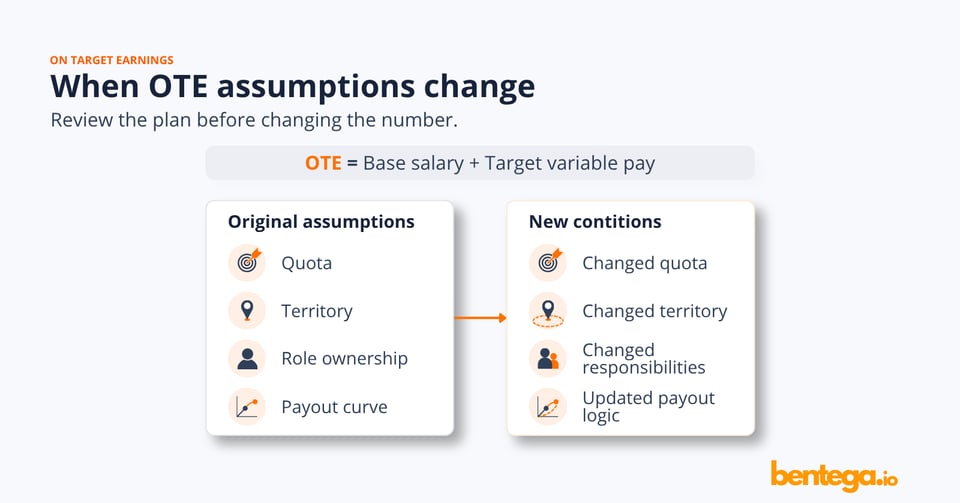
An OTE plan is usually designed around a set of assumptions.
A salesperson has a certain territory. There is an expected level of market demand. The company has a particular pricing model, sales cycle and product mix. A quota is set based on those assumptions, and the target variable pay is designed around the performance expected from the role.
Then the business changes.
Perhaps demand slows down. A territory is split between two people. Prices increase. The company moves upmarket. A salesperson takes over an existing book of business. A role that previously focused on new customers becomes responsible for expansion as well.
At that point, the question is not simply whether OTE should go up or down. The more useful question is whether the assumptions underneath the existing compensation plan still make sense.
That distinction matters because the OTE itself may not be the thing that needs changing.
If you need the basic relationship between base salary, target variable pay and OTE first, our on-target earnings guide covers the fundamentals. Here, I want to focus on what happens when a plan is already running and the business conditions around it change.
Start by identifying what actually changed
Imagine an Account Executive with a €100,000 OTE:
Base salary: €70,000
Target variable pay: €30,000
Annual eligible quota: €300,000
If the market changes and the company believes €300,000 is no longer a realistic target for that territory, there are several different decisions it could make.
It could change the quota. It could change which revenue counts toward the quota. It could change the territory. It could change the commission mechanics. It could change the target variable pay itself.
Those decisions are related, but they are not the same.
I would therefore start with the operating assumption that has changed rather than immediately changing the compensation number.
If the problem is that the territory has lost half of its potential accounts, that is primarily a territory and quota question. If the role itself now has less direct responsibility for revenue, that may become a pay-mix question. If the company has moved from annual contracts to larger multi-year deals, the issue may be how eligible performance is measured.
Changing the OTE because “the market changed” can easily solve the wrong problem.
Separate the OTE from the mechanics underneath it
OTE describes the earnings expected when the plan's target conditions are achieved.
It does not, by itself, define those conditions.
The same €100,000 OTE could sit on top of several different plans. One person may need to close €300,000 in eligible business. Another may carry a €600,000 quota. A third may have a combination of new-business and expansion targets.
That is why I would separate four questions when reviewing a plan:
What is the target compensation?
Base salary plus target variable pay.
What is target performance?
Quota, retention target, expansion target or another defined measure.
How does performance turn into payout?
Rates, thresholds, tiers, accelerators and caps.
What performance is eligible?
Customers, products, contract values, periods and ownership rules.
A change in one of those areas does not automatically require changing all the others.
This becomes particularly important when the plan is already active.
A quota change can alter the economics even when OTE stays the same
Take the €100,000 OTE example again.
The salesperson has €30,000 of target variable pay and a €300,000 quota. In a simple flat-rate plan, that implies a 10% rate at target.
Now assume the company reduces the quota to €240,000 because the territory has materially changed.
If the target variable pay remains €30,000, a simple flat-rate structure would now require an implied rate of:
€30,000 ÷ €240,000 = 12.5%
If the company instead keeps the old 10% rate, reaching the new €240,000 quota would generate only €24,000 of variable pay.
The salesperson could therefore reach 100% of the new target but earn €94,000 rather than the stated €100,000 OTE.
Neither outcome is necessarily what the company intended.
This is why changing a quota in isolation can create a compensation problem even when nobody has formally changed the OTE.
Before approving a new target, I would always recalculate what happens to target earnings under the actual payout rules.
The OTE calculator can be useful here for checking how different quota and payout assumptions affect the result before the change is introduced.
Changing the target halfway through the period creates a different problem
Changing next year's quota is relatively straightforward.
Changing this quarter's quota on 15 August is not.
By that point, employees may already have performance against the existing plan. Opportunities are in the pipeline. Some deals may have closed. Accelerators or thresholds may already have been reached.
The company therefore needs an effective date.
Suppose a new quota takes effect on 1 September. The plan should explain which performance belongs to the old structure and which belongs to the new one.
That sounds simple until you look at actual opportunities.
What happens to a deal created in July but closed in September? What happens if the account changes owner in August? What happens to an opportunity where two employees contributed under different territory structures?
Those are operational decisions rather than OTE formulas.
The important part is to make them before the first disputed transaction appears.
Decide how existing pipeline will be treated
Pipeline is often where a mid-period change becomes difficult.
Imagine an AE has worked on a €100,000 opportunity for four months. Shortly before the deal closes, the territory is reorganized and the account moves to another salesperson.
There are several possible treatments. The original AE might retain full credit, the credit could transfer, or the company could split it.
What matters is that the treatment follows a defined rule rather than being negotiated after the outcome is known.
The same applies when quotas change.
If the old quota applied while the opportunity was being developed but the new quota applies when it closes, which target receives the credit?
There is no universal answer because companies use different crediting models. But there should be an answer.
A compensation change that ignores existing pipeline usually leaves managers and Finance to create that answer transaction by transaction.
Territory and role changes need the same treatment
Market conditions are not the only reason an OTE plan may stop matching reality.
An employee can change territory. A role can move from SMB to enterprise. Customer Success can take over commercial responsibility for renewals. A company may introduce Account Management between Sales and CS.
Those changes affect what the employee can realistically influence.
Suppose an Account Executive originally owned new business and expansion, but expansion responsibility moves to Customer Success halfway through the year.
Leaving the AE's target unchanged may mean they are still expected to achieve performance from a revenue stream they no longer control.
At the same time, giving Customer Success responsibility for expansion without changing its targets or variable-pay opportunity creates the opposite problem.
This is why role changes and compensation changes need to be considered together.
Our OTE-by-role guide goes deeper into how target variable pay and performance measures should relate to what Sales, Customer Success and other roles actually own.
Be careful about changing pay mix to solve a temporary problem
The current version of this article recommends moving compensation from variable to fixed pay when market conditions become difficult. I would not use that as a general recommendation.
Changing someone's base salary and target variable pay is a much larger compensation decision than adjusting a quota assumption.
If the original structure was:
€70,000 base + €30,000 target variable = €100,000 OTE
and the company changes it to:
€80,000 base + €20,000 target variable = €100,000 OTE
the headline OTE has not moved at all.
But the plan is materially different.
The employee carries less earnings variability, while the company has increased its fixed compensation cost and reduced the amount of pay linked to performance.
There may be situations where that is appropriate, particularly if the role itself has changed. But I would not use pay mix as a short-term adjustment simply because one quarter has become difficult.
The first question should still be whether the role, target or market assumption has structurally changed.
Material changes to employment terms may also require HR or legal review depending on the employee, agreement and jurisdiction.
Changing what you reward is not the same as adjusting OTE
Another response to changing conditions is to change the metric.
Perhaps new customer acquisition becomes harder and the business wants more focus on expansion. The company could therefore decide that existing customers should play a larger role in the incentive plan.
That may be commercially sensible.
But it is not just an OTE adjustment.
You have changed what success means for the employee.
If an AE was previously rewarded only for new business and now receives a target for expansion as well, the company needs to define which accounts the person owns, which expansion events qualify and what happens when Customer Success contributes to the same opportunity.
Otherwise the plan can create duplicate credit or unclear ownership even if the total OTE remains unchanged.
For SaaS companies, our SaaS OTE guide covers this relationship between new business, recurring revenue, renewals and expansion in more detail.
Recheck thresholds and accelerators when the target changes
Quota changes can also affect the rest of the payout curve.
Suppose an accelerator begins at 100% attainment.
Under a €300,000 quota, the accelerator begins after €300,000 of eligible performance.
Reduce the quota to €240,000 and the accelerator may now begin at €240,000.
That might be exactly what the company intends.
But it should be tested.
The same applies to thresholds, tiers and caps. If the quota changes but the rest of the mechanics stay untouched, the economics above and below target may move more than expected.
I would therefore model at least a few scenarios whenever a material target changes:
80% attainment, 100%, 120%, and one unusually strong outcome.
The target case tells you whether the OTE still reconciles.
The other scenarios tell you whether the payout curve still behaves the way you intended.
Do not quietly rewrite performance that has already been earned
This is perhaps the most important distinction in a mid-period change.
There is a difference between changing how future performance will be treated and going back and changing the rule applied to performance that already occurred.
Suppose a deal was credited under the plan in force in June.
The company then changes its commission structure in July.
Applying the July rule to the June deal may produce a different payout, but it also creates a much harder governance question: which plan actually applied when the performance was earned?
That is why previous periods and plan versions matter.
A company should be able to determine which rules applied to a given performance event rather than simply recalculating history using whichever configuration happens to be current today.
Where contracts, employment terms or local regulation affect what can be changed, appropriate HR or legal review is needed. The operational principle remains useful regardless: prospective changes are much easier to govern when their effective date is explicit.
Communicate the before and after, not just the new number
Once the change is decided, employees need more than a new OTE or quota figure.
I would explain the difference between the old and new plan.
For example:
Until 31 August: €300,000 quota, 10% flat rate.
From 1 September: €240,000 annualized target basis, with payout mechanics adjusted so target variable pay still reconciles to €30,000.
Then explain what happens to existing opportunities, how performance around the effective date will be credited and whether anything changes above or below target.
That gives employees something concrete to evaluate.
It also means managers, RevOps, Finance and the employee are working from the same version of the change.
The guide to communicating OTE to employees covers the broader information employees should understand about their targets, earning rules, payout timing and plan changes.
Keep the previous plan available
Replacing the old document with a new one may feel tidy.
Operationally, it removes useful context.
If somebody asks three months later why a July deal was calculated differently from an October deal, the company should be able to identify the plan that applied to each event.
That does not mean every employee needs to navigate a library of old compensation documents.
It does mean the company should retain the relevant plan version, effective dates and change history.
This becomes increasingly important when several things change at once. A new quota might coincide with a territory change, a new manager, different crediting or a change in the payout curve.
Without a dated reference point, later payout questions become questions about people's memory.
Review the plan when assumptions change, not simply because the calendar says so
A regular compensation review is useful, but I would not redesign the plan every quarter just because another review date arrives.
The better trigger is usually a meaningful change in the assumptions behind the plan.
That might be a substantial territory change, a new sales motion, different role ownership, a major pricing change, a new product, a material shift in the achievable market or persistent evidence that the target mechanics no longer reconcile with what the company intends.
Sometimes the review confirms that nothing should change. That is a perfectly valid outcome.
The purpose of reviewing the plan is not to keep modifying it but to make sure the assumptions still hold.
A practical example
Consider an Account Executive entering the year with the following plan:
Six months into the year, the territory is materially reduced.
Management decides that the remaining annual target should be lowered so the salesperson is no longer expected to produce revenue from accounts that have moved elsewhere.
Before making the change, the company needs to decide more than the new quota.
It should determine the effective date, which existing opportunities remain with the employee, how quota attainment before the change is preserved, whether the payout rate needs to change to keep the €30,000 target variable amount intact, and what happens to accelerators already reached.
Only after those questions have been answered does the new quota become operational.
That is the difference between changing a number in a spreadsheet and changing a compensation plan.
Frequently asked questions on adapting OTE to market changes
.png?height=200&name=Whats%20in%20OTE%20(1).png)
.png?height=200&name=OTE%20Reality%20Check%20(1).png)
.png?height=200&name=The%20Gong%20Show%20(1).png)