

There is a fairly simple test for whether an OTE plan has been communicated properly.
Ask the employee to explain it back to you.
What is the base salary? What is the target variable pay? What do they need to achieve to earn it? Which performance counts? When does the calculation become final? And what happens if something changes?
If the answers are unclear, sending another slide deck with the OTE number in larger font probably will not solve much.
Good OTE communication is mainly about making the rules behind the number understandable.
If you need the basic definition, formula and pay-mix concepts first, our on-target earnings guide covers those. Here, I want to focus on what an employee should actually understand once the plan is introduced.

Start with the number, but do not stop there
Suppose an employee has:
Base salary: €70,000
Target variable pay: €30,000
OTE: €100,000
The first part of the explanation is straightforward. If the employee reaches the performance level defined by the plan, total target compensation is €100,000.
But that leaves most of the useful questions unanswered.
What performance produces the €30,000? Is it one target or several? Does the employee earn anything below target? Can payout exceed €30,000? When is performance measured? And when is the resulting amount actually paid?
The OTE number tells the employee what target earnings are. The plan needs to explain how they get there.
Explain what the employee is actually being measured on
This is where I would spend most of the conversation.
If someone has €30,000 of target variable pay, they should be able to explain what needs to happen for them to earn that €30,000.
For an Account Executive, that may be performance against an eligible sales quota. An SDR might be measured on qualified pipeline or accepted opportunities. A Customer Success role could have retention or expansion responsibility.
Those are different plans even if the employees happen to have the same OTE.
The important thing is to use the same definitions in the employee conversation that will later be used in the calculation. If a plan pays on “qualified opportunities,” for example, explain exactly what makes an opportunity qualified and who confirms it.
Broad language such as “grow revenue” or “support retention” may describe the objective of the role, but it is not enough to explain a compensation calculation.
Our OTE-by-role guide goes further into how the underlying measures can differ across Sales, SDR, Customer Success and Marketing.
Make the target concrete
Knowing the metric is only half the explanation. The employee also needs to know what target performance actually means.
If the variable pay is connected to a €500,000 annual quota, say so. If there are quarterly targets that add up to the annual quota, explain how those periods relate to one another.
The same applies to non-sales measures.
A Customer Success employee might have a retention target. An SDR might have a target number of accepted opportunities. A team bonus could depend partly on an overall company result.
The employee should not have to reverse-engineer the target from a later payout statement.
It should be clear from the beginning which performance level represents 100% attainment and therefore the target variable payout.
Show what happens below and above target
This is where a numerical example is often more useful than another paragraph in the compensation policy.
Suppose target variable pay is €30,000. If the plan is linear, 80% attainment might produce €24,000 and 100% attainment produces €30,000.
But perhaps the plan is not linear.
There may be a threshold before payout starts. An accelerator may apply above 100%. Different rates may apply at different performance levels, or the plan may have a cap.
If that is the case, show it.
An employee should be able to see what happens at a few realistic performance levels rather than only seeing the target case.
For example:
These numbers are only illustrative. The point is that the employee should understand the shape of the plan before real performance starts running through it.
The OTE calculator can be useful here because it lets you model target, below-target and above-target scenarios before the plan is communicated.
Explain what counts before you explain the payout
A salesperson can understand the commission rate perfectly and still be surprised by the payout if they misunderstood which deals were eligible.
This is why the earning rules need to be part of the communication.
If commission is based on closed-won deals, what does closed-won mean for compensation purposes? If a customer signs a three-year agreement, which contract value counts? If two people contribute to the same sale, who receives the credit?
The same problem appears outside Sales. If Customer Success is rewarded for expansion, the plan should say which accounts the employee owns and what happens when ownership changes during the period.
A calculation is only understandable when the employee can connect it back to the performance that went into it.
Separate performance, approval and payment
This is another distinction I would explain early because it prevents a lot of unnecessary confusion later.
Suppose an employee closes an eligible deal on 25 March.
The deal may count toward March performance. The commission may be calculated after the period closes. A manager or Finance may then review and approve it, and the resulting amount might be paid in April payroll.
Those dates serve different purposes.
The employee should understand when performance is credited, when the amount is reviewed, when it becomes approved and when it is expected to be paid.
This becomes particularly important if the company uses quarterly bonuses, customer-payment conditions or longer measurement periods.
Saying “you earn 10% commission” without explaining when the 10% moves from performance to calculation to payment leaves quite a lot open to interpretation.
Explain accelerators, thresholds and caps with examples
Plan mechanics can sound much more complicated than they actually are when they are described only in policy language.
Take an accelerator.
You could write several paragraphs explaining that the commission rate increases once quota attainment exceeds a defined threshold.
Or you could show an employee what happens to the next €20,000 of performance after they cross 100%.
I would normally do both, but the example is what makes the rule real.
The same applies to thresholds and caps. Employees should know whether there is a minimum level of attainment before payout starts, whether a higher rate applies only to performance above a threshold, and whether the total payout has a maximum.
Do not make employees discover those rules when they receive the first payout.
Explain what happens when the data changes
Variable pay is based on operational data, and operational data changes.
A deal may be corrected. Customer ownership can change. An expected project cost can turn out differently. A transaction may have been attributed to the wrong person.
The important thing for the employee is knowing how the company handles that situation.
Does an open calculation update before approval? Is an approved period locked? How is a later correction recorded? Who reviews an exception?
The employee does not necessarily need every internal Finance process, but they should understand that changes are handled through a defined process rather than by somebody silently replacing a number.
That distinction matters for trust.
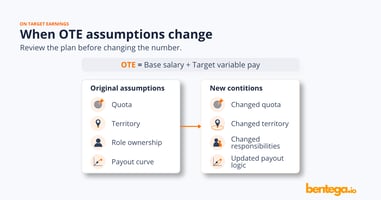
Plan changes should be communicated as changes
This sounds obvious, but I think compensation changes are sometimes communicated as though they were simply an updated version of the same document.
If the company changes the quota, commission rate, performance metric or ownership rule, tell employees what changed, when the new rule becomes effective and which performance is affected.
Imagine a new plan becomes effective on 1 July while several opportunities are already in the pipeline.
Employees will naturally ask what happens to deals created in June but closed in August.
That question should have an answer before the new plan takes effect.
A dated plan version is much easier to explain than a document that keeps changing while everyone assumes they are still working under the same rules.
Employees need somewhere to see progress
A good explanation at the start of the year does not help much if the employee then spends the next eleven months guessing.
Where possible, employees should be able to see the performance data relevant to their plan, their current attainment and how calculated variable pay connects back to that performance.
That visibility also makes conversations with managers more useful.
Instead of spending a review meeting trying to establish which deals or metrics are included, the conversation can focus on performance and the parts of the result that actually need attention.
This is one of the reasons visibility is part of compensation communication, not only a reporting feature.
Managers need to understand the plan too
The employee is not the only person who needs a good explanation.
Managers will usually become the first point of contact when somebody asks why their payout looks different from what they expected.
If the manager interprets the plan differently from HR, RevOps or Finance, communication breaks down very quickly.
Before rolling out a new plan, I would therefore make sure managers can explain the same basics: target compensation, performance measure, target, earning rules, payout curve, timing and exception process.
They do not need to become compensation administrators. They do need to avoid inventing their own interpretation of the plan in a one-to-one meeting.
Do not hide uncertainty behind the OTE number
There is another part of OTE communication that I think deserves more attention.
OTE is a target compensation number. It should not be presented as though it were guaranteed salary.
An employee should understand how much compensation is fixed, how much depends on performance and what assumptions sit behind the target variable amount.
That is particularly important during recruitment.
A candidate comparing two roles with the same €120,000 OTE may be looking at very different compensation structures. One might have €90,000 fixed and €30,000 variable, while another has a 50/50 split.
The target number alone does not describe the amount of compensation risk the employee is taking.
Clear communication means showing the pay mix as well as the headline OTE.
A practical way to explain an OTE plan
If I were introducing a new OTE plan to an employee, I would try to get through the first explanation without turning it into a compensation seminar.
Something along these lines is usually enough:
Your base salary is €70,000 and your target variable pay is €30,000, giving you an OTE of €100,000. Your annual target is €300,000 of eligible performance. At 100% attainment, the plan is designed to pay the full €30,000 variable amount.
Then explain how eligible performance is defined, what happens below and above target, when results are measured and when approved payouts are paid.
After that, show one normal example and one edge case.
For example, what happens at 120% attainment? What happens when two people share credit on a deal?
That gives the employee something concrete to attach the plan language to.
What an employee should be able to answer
After the plan has been communicated, I would expect the employee to understand the following:
- What is my base salary?
- What is my target variable pay?
- What is my OTE?
- What performance is measured?
- What is my target?
- Which transactions or results count?
- What happens below and above target?
- Are there thresholds, accelerators or caps?
- When is performance measured?
- When is the result reviewed and approved?
- When should I expect payment?
- What happens if the data or ownership changes?
- Where can I see my current performance and payout?
- Who do I contact if something looks wrong?
If several of those questions cannot be answered, the problem is probably not that the employee needs another reminder email.
There is likely still something in the plan or the process that needs to be made clearer.
.png?height=200&name=OTE%20Reality%20Check%20(1).png)
.png?height=200&name=The%20Gong%20Show%20(1).png)