

A retention bonus, sometimes called a stay bonus, is a payment offered to an existing employee to encourage them to remain with the company through a defined period, event or transition. Unlike a performance bonus, the primary condition is usually continued employment rather than achieving a KPI or performance target.
For example, a company might offer a key employee a €15,000 retention bonus if they remain through the completion of a 12-month system implementation. The idea is simple. The details are not.
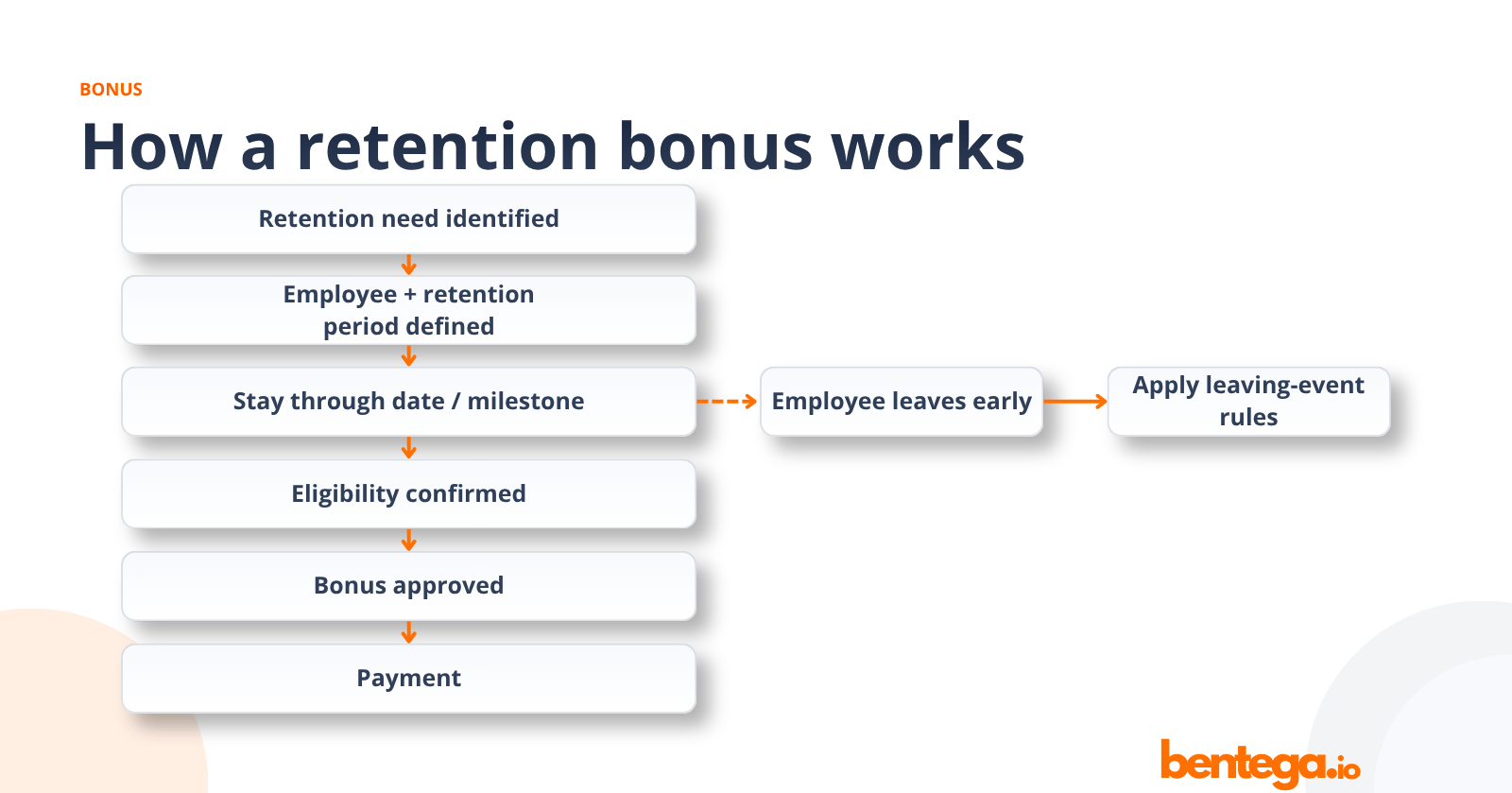
A useful retention bonus arrangement should define who is eligible, how long the employee needs to stay, when the bonus is earned, when it is paid, and what happens if the employment relationship ends before the relevant date.
For the broader framework around bonus types, calculations and governance, see our bonus guide.
What is a retention bonus?
A retention bonus is additional compensation offered to an employee in exchange for remaining with the company until a defined date, milestone or event. It is commonly used when losing a particular employee during a specific period would create additional business risk.
Situations might include:
- a merger or acquisition
- a restructuring
- a leadership transition
- completion of a critical project
- a major implementation or migration
- a period where specific skills or institutional knowledge are particularly important
A retention bonus is therefore different from simply increasing someone's salary. It addresses a defined retention period or business event rather than permanently increasing fixed compensation.
Retention bonus meaning
The simplest structure is:
Remain employed through the defined retention period → become eligible for the agreed retention bonus
That makes the primary condition different from a performance bonus.
For example:
An employee is offered €12,000 if they remain employed through 31 December.
The employee does not necessarily need to achieve 110% of a KPI or complete a sales target to earn the retention bonus. The central condition is staying through the agreed period, subject to whatever additional terms the company has defined.
Why do companies use retention bonuses?
A retention bonus is most useful when the company faces a specific period of retention risk.
For example, imagine a company is completing a major ERP implementation. One employee has deep knowledge of the existing systems, integrations and financial processes. If that employee leaves halfway through the implementation, the company could lose important knowledge and continuity.
A retention bonus can create an additional financial reason for the employee to remain through completion. That is different from trying to solve general employee engagement with a one-time payment.
A retention bonus is best thought of as a tool for a defined retention problem, not a substitute for competitive compensation, management quality or a healthy working environment.
When should a company consider a retention bonus?
A retention bonus may make sense when three things are true:
- The company needs the employee to remain through a specific period or event.
- Losing the employee during that period would create meaningful disruption or risk.
- The company can define clearly when the retention obligation has been satisfied.
Examples include:
Merger or acquisition
Key employees may be needed to preserve customer relationships, systems knowledge or operational continuity through a transaction and integration. If you're the target of an acquisition, and a founder, you should expect that the T&C's will require you to stay on for a number of years after the transaction has completed to help with business integration.
Critical project
A company may need employees to remain until a product launch, system migration or transformation project has been completed. These employees may hold technical knowledge, understand important dependencies or manage relationships that would be difficult to replace midway through the work.
Leadership transition
A senior employee may be asked to remain during a planned handover to new leadership. They may hold important knowledge about strategic decisions, customer relationships, financial commitments or day-to-day operations that a successor needs time to understand.
Organisational restructuring
Specific people may hold knowledge or responsibilities that are important while roles, systems or processes are being reorganised. They may understand how work moves between departments, which controls need to remain in place or who is responsible for critical customer and supplier commitments.
Temporary talent risk
The company may face a period where losing employees with particular skills would be unusually disruptive. This could happen when a specialist role is difficult to fill, several experienced team members are unavailable or replacement employees need time to learn the company's systems and processes.
Retention bonus example
Consider a company implementing a new financial system.
The implementation is expected to take 12 months. A Finance manager holds significant knowledge about:
- the existing system
- reporting processes
- historical data
- integrations
- month-end procedures
The company offers the manager a €20,000 retention bonus with the following condition:
The employee must remain employed through successful completion of the implementation on 30 June 2027.
If the employee remains through that date, the €20,000 becomes payable according to the terms of the arrangement. This is a basic retention structure.
The company still needs to decide what happens if:
- the project finishes earlier
- the project is delayed
- the employee is made redundant
- the employee becomes unable to work
- the employee resigns
- the company changes the employee's role
- the company terminates employment
Those conditions should not be left until the event occurs.
How to structure a retention bonus
A retention bonus does not need a complicated calculation, but it does need clear rules.
1. Define the retention objective
Start by identifying why the company needs the employee to stay.
For example:
Maintain continuity through the ERP implementation.
That is much clearer than:
Improve retention.
A specific objective makes it easier to define the relevant period and employee population.
2. Define who is eligible
A retention plan may apply to:
- one employee
- a group of key employees
- a specific department
- managers
- executives
- employees involved in a particular project
The company should be able to explain why each participant is included.
3. Define the retention period
The plan needs a clear beginning and end.
For example:
1 January 2027 to 31 December 2027
or:
From signing until completion of Project Atlas.
Using a milestone can make sense, but the milestone itself needs to be defined clearly.
4. Define the bonus amount
The amount can be structured as:
- a fixed payment
- a percentage of salary
- staged payments
- different amounts for different employee groups
There is no universal correct amount.
The appropriate level depends on factors such as the importance of the employee, length of the retention period, compensation package and business context.
5. Define when the bonus is earned
This is one of the most important parts.
For example:
The employee earns the full retention bonus by remaining employed through 31 December.
That is different from paying the employee upfront and later requiring repayment if they leave.
The plan should distinguish clearly between:
- when the employee becomes eligible
- when the amount is considered earned under the arrangement
- when the amount is actually paid
6. Define leaving-event rules
The plan should explain what happens if employment ends before the retention date.
Different situations may need different treatment.
For example:
- voluntary resignation
- termination by the company
- redundancy
- retirement
- long-term absence
- death
- mutually agreed departure
The appropriate treatment can depend on the employment agreement and applicable law, so jurisdiction-specific terms should be reviewed appropriately.
7. Define who approves exceptions
Unexpected situations occur. If the company wants discretion to make exceptions, define who has authority to approve them.
That might be:
- CEO
- CFO
- HR
- compensation committee
- board
- another designated approver
The decision should not depend only on whoever happens to be processing the payment.
Lump-sum vs. staged retention bonuses
Retention bonuses do not always need to be paid in one amount.
Two common approaches are particularly useful.
End-of-period payment
The full amount is paid after the employee completes the retention period.
For example:
€20,000 after 12 months.
This is simple and creates a clear retention point.
However, the employee receives nothing until the end of the period.
Staged retention bonus
The amount is divided across several milestones.
For example:
- €7,500 after six months
- €7,500 after twelve months
- €5,000 after project completion
This can provide reinforcement throughout a longer retention period.
The company then needs to define whether each stage is earned independently or whether later events can affect amounts already paid.
Retention bonus with repayment terms
Some arrangements pay part or all of the bonus before the retention requirement has been fully satisfied.
That creates a different operational question.
For example:
The employee receives €10,000 immediately but must repay some or all of it if they voluntarily leave within 12 months.
If a company uses this structure, it should define:
- which events trigger repayment
- whether repayment is full or prorated
- how the repayable amount is calculated
- when repayment becomes due
This is one reason to distinguish carefully between a retention condition and a clawback or repayment provision.
If the bonus is only paid after the employee has completed the retention period, there may be no previously paid retention amount to reclaim.
Example: staged retention bonus
Consider a 24-month transformation project.
A critical employee is offered a €30,000 retention opportunity.
The company structures it as:
This structure gives the employee several retention milestones rather than placing the entire incentive at the end.
The agreement still needs to define what happens if the project timeline changes.
Retention bonus vs. signing bonus
Both are designed around employment decisions, but they operate at different moments.
A signing bonus answers:
What would encourage this person to join us?
A retention bonus answers:
What would encourage this employee to remain through this period?
For more on the first case, see our signing bonus guide.
Retention bonus vs. performance bonus
A retention bonus and performance bonus can also look similar because both involve variable compensation. But the earning conditions are different.
-
A retention bonus primarily rewards continued employment.
-
A performance bonus rewards performance against defined results.
For example:
Stay through 31 December → retention bonus.
versus:
Achieve 95% customer retention → performance bonus.
A company could use both, but the employee should be able to understand which condition applies to each payment.
For more on performance-based plans, see our performance bonus guide.
Retention bonus vs. customer retention bonus
These terms can sound confusingly similar.
A retention bonus normally refers to retaining an employee.
A customer-retention bonus or retention KPI incentive may instead reward an employee for retaining customers.
For example:
Employee remains through a 12-month restructuring → employee retention bonus.
Customer Success Manager achieves a 95% GRR target → performance bonus based on customer retention.
Those are two different incentive mechanisms.
This distinction is particularly important when companies use “retention” as both an HR concept and a commercial KPI.
Should retention bonuses include performance conditions?
They can, but companies should be clear about what they are building.
Suppose an employee receives €20,000 only if they:
- remain through a 12-month period, and
- successfully deliver a defined project milestone.
The plan now combines:
- a retention condition
- a performance or delivery condition
There is nothing inherently wrong with that. But the company should not describe it as a simple stay bonus if payout actually depends on several independent conditions. Clear terminology makes the plan easier to explain and administer.
Common retention bonus mistakes
Using a retention bonus for a permanent problem
If employees are leaving because compensation is persistently uncompetitive or working conditions are poor, a one-time bonus may only postpone the underlying issue. It creates a financial reason to stay until a particular date, but it does not correct an ongoing salary gap, excessive workload or poor management.
Leaving the end date ambiguous
“Stay until the project is finished” sounds clear until the project is delayed by six months. Without a precise endpoint, the employee and company may have different expectations about how long the commitment lasts and when the bonus is earned. A change in the project schedule should not leave either party guessing about the retention terms.
Use a defined date, a clearly defined milestone, or rules for what happens if the timeline changes.
Failing to define leaving events
The company should not wait until an employee leaves to decide whether the bonus is still payable. Voluntary resignation, redundancy, termination by the company and a mutually agreed departure may require different treatment. Without written rules, the employee, manager and payroll team may reach different conclusions about the same arrangement.
Confusing earned and paid
An amount can be calculated, approved or communicated without necessarily being earned or payable under the retention agreement. Approving the arrangement may confirm the employee's bonus opportunity, while earning the bonus depends on satisfying the agreed conditions. Payment is a separate step: the transfer of the amount through payroll or another agreed process.
Define the relevant states clearly.
Using repayment language without defining it
“Must repay the bonus if you leave” is not enough. The employee needs to understand which departures trigger repayment, how much they would owe and when repayment becomes due. Voluntary resignation, redundancy and termination by the company should not be treated as interchangeable unless the agreement explicitly provides for that treatment and it's permitted under applicable law.
The agreement should specify whether repayment is for the full amount or reduces as the employee completes the retention period. If it is prorated, define the calculation method, including how partial months are treated. In short, the agreement should specify the trigger, amount and timing.
Making the plan unnecessarily complex
If continued employment is the only behaviour the company wants to influence, the plan may not need five KPIs and a complicated payout curve. Adding performance measures, weightings and thresholds can make it harder for employees to understand what they need to do to earn the bonus.
Governance and approval
Even a simple retention bonus should have an identifiable record of:
- participant
- bonus amount
- retention period
- applicable terms
- effective date
- payment date
- leaving-event treatment
- approval
- subsequent adjustments where applicable
This becomes particularly important when several employees have different retention dates or arrangements.
The purpose is straightforward:
The company should be able to explain why a particular employee received a particular amount and which terms applied.
How Bentega can support retention bonuses
Retention bonuses can be straightforward when one employee has one payment date.
They become more operationally demanding when the company has:
- multiple participants
- different retention periods
- different bonus amounts
- staged payments
- changing employee status
- approvals
- adjustments
- other bonus plans running alongside the retention arrangement
Bentega can support bonus and variable-pay workflows where participants, plan rules, effective periods, calculations, approvals and payout activity need to be managed in a structured process. Retention arrangements can therefore sit alongside other incentive plans rather than being managed as isolated spreadsheet calculations.
A retention bonus should solve a defined retention problem
A retention bonus works best when the company can explain exactly:
- who it needs to retain
- why that employee needs to stay
- through which period or event
- what the employee will receive
- when the amount is earned
- when it will be paid
- what happens if employment ends early
That clarity matters more than creating an elaborate formula.
For the broader framework around bonus plans, calculations and governance, continue with our bonus guide.